1. We give out full size candies 2. Make a listing of all costumes 3. Make a timelapse movie
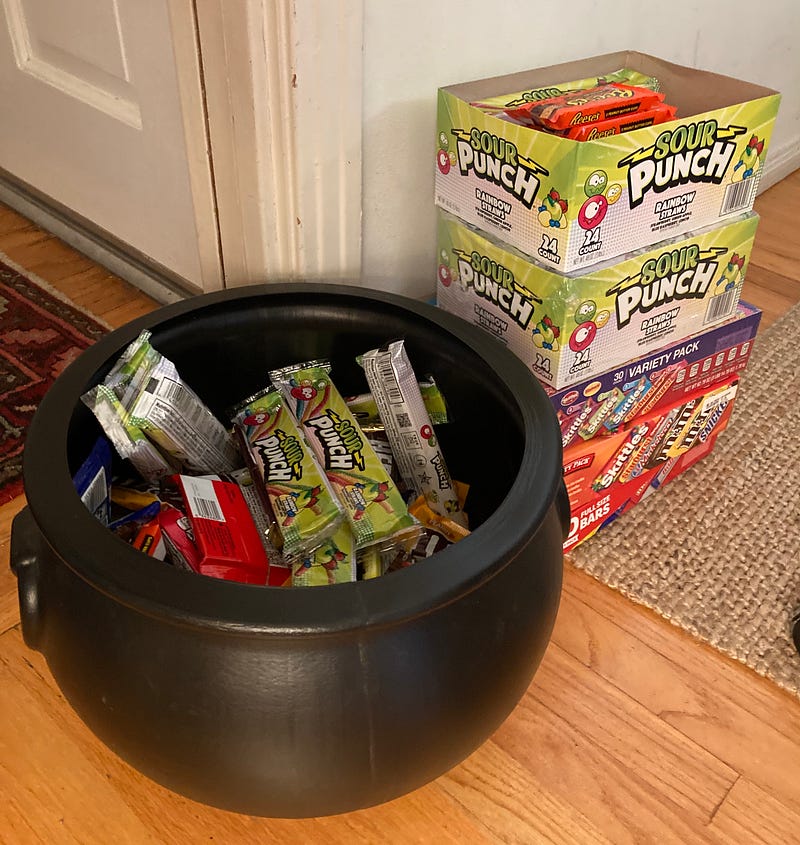
I let the kids choose their favorite candy themselves. This can sometimes lead to a prolonged choosing process and debate. The moments of “OMG” and “wow” are wonderful as they realize the candies are full size.
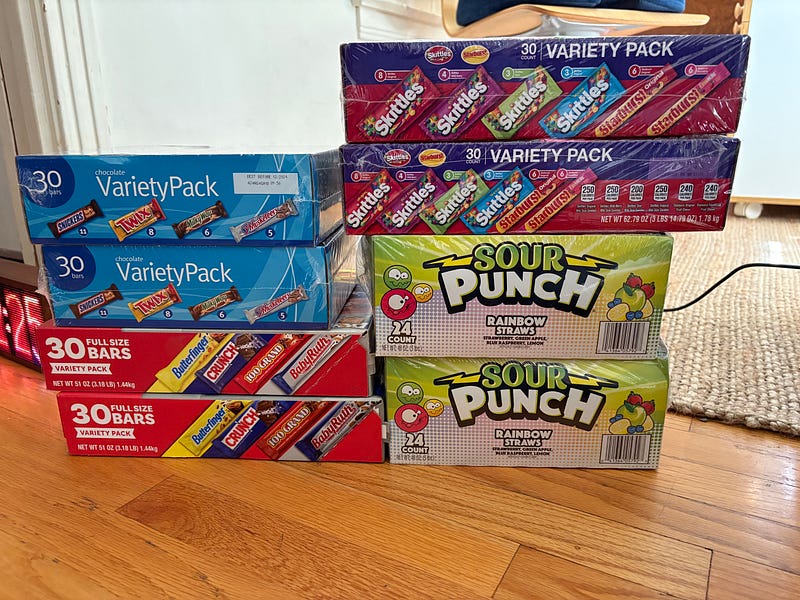
Full size candy
The excitement upon seeing full size candies makes it all worth it.
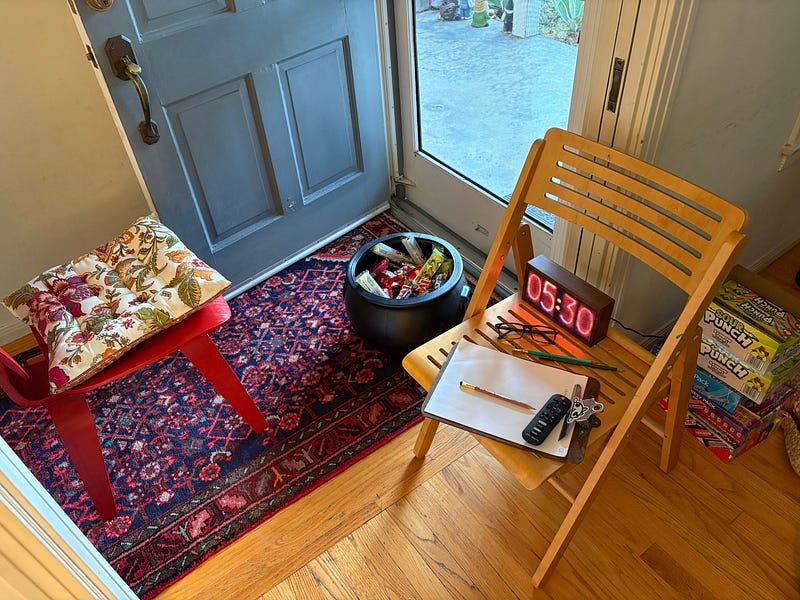
Ready for the kids to arrive
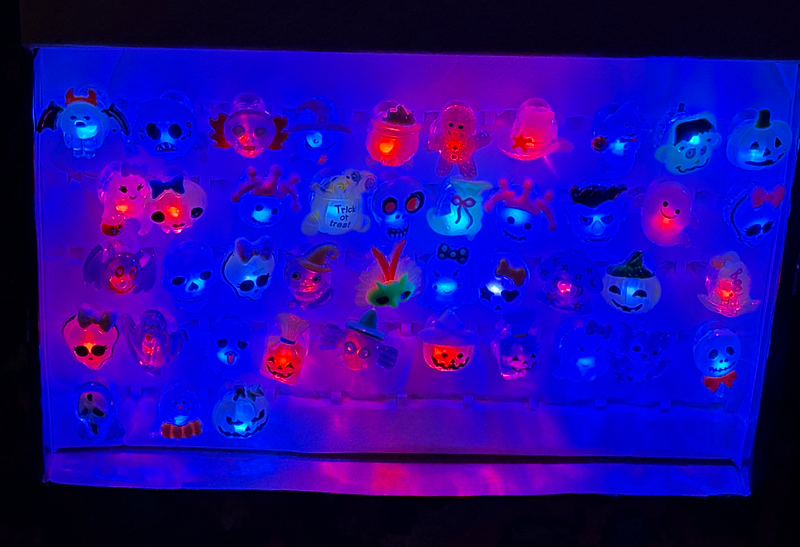
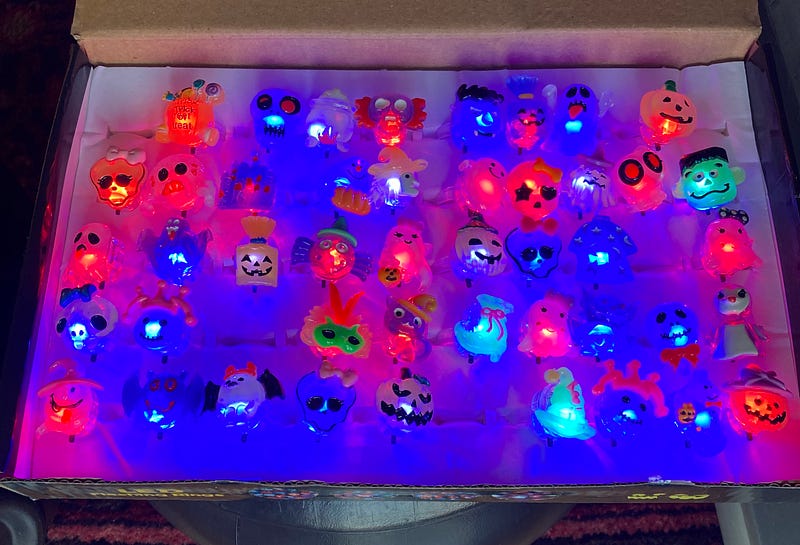
I also gave out LED light up rings this year again. Kids of every age enjoy them.
Kids would spend more time choosing a ring than candy.
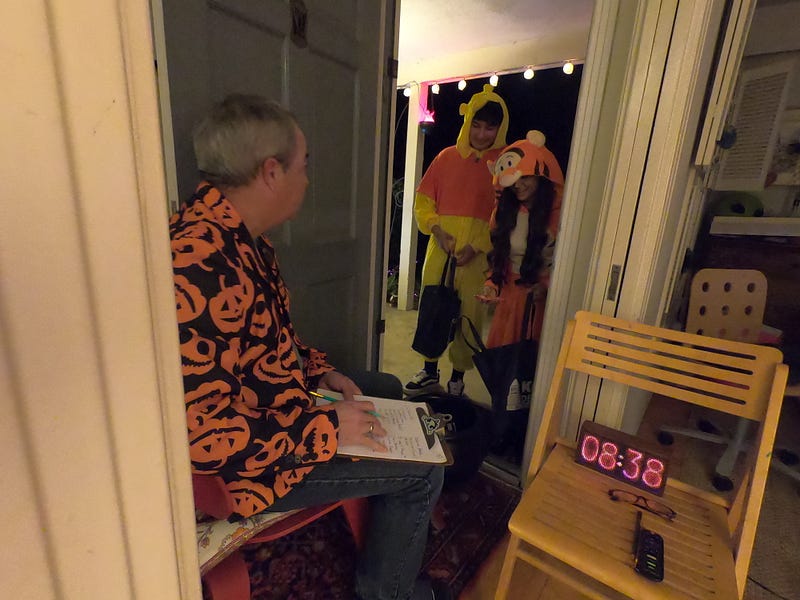
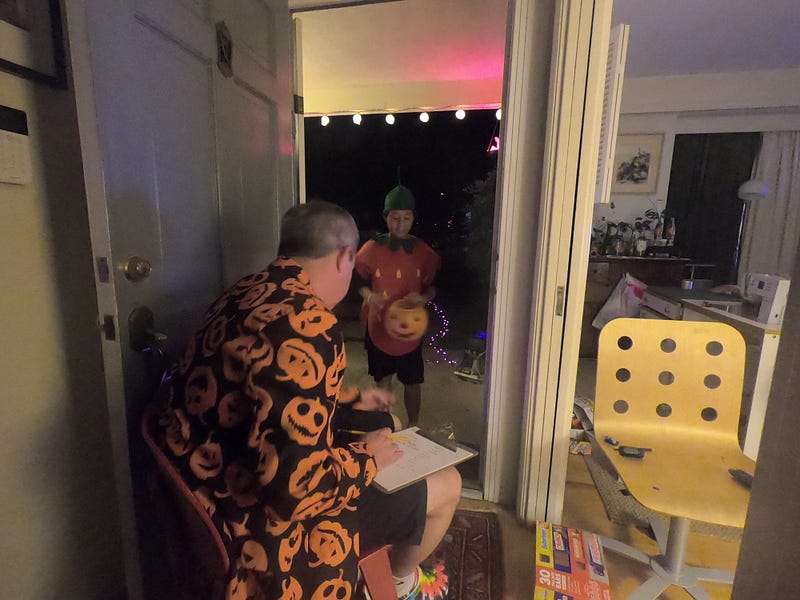
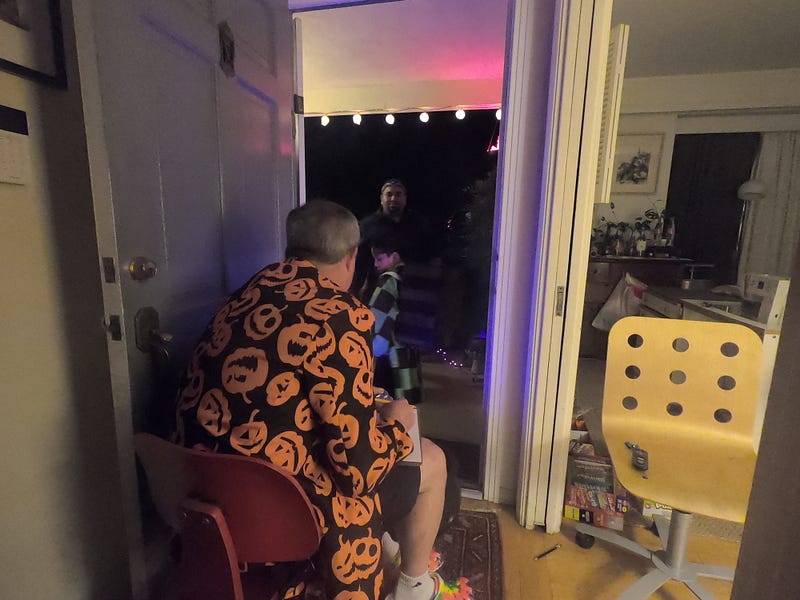
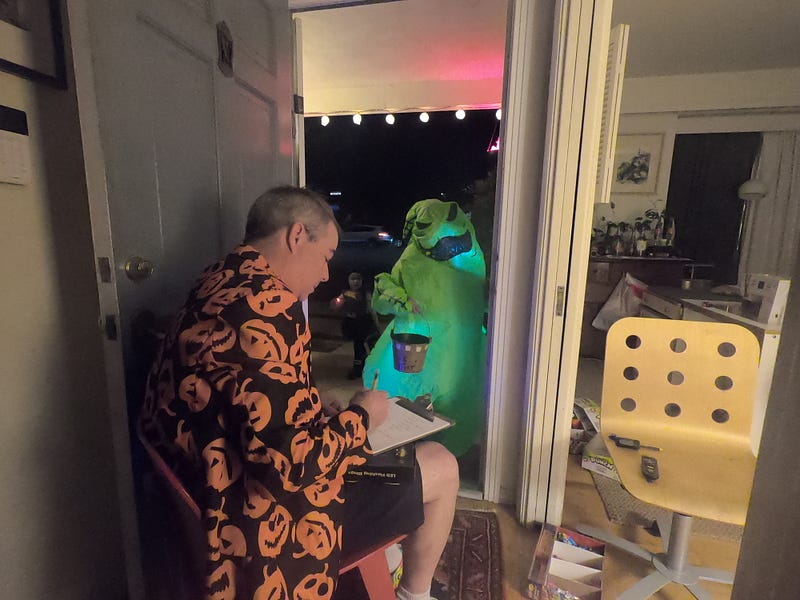
When people come to the door, I ask every person what they were dressed as and wrote down their answers. I am careful to ask what they are, accepting their answers rather than interpreting what I see.
The time-lapse takes place over about three and a half hours that is reduced to around 90 seconds for your viewing pleasure.
A few of the costumes I liked this year.
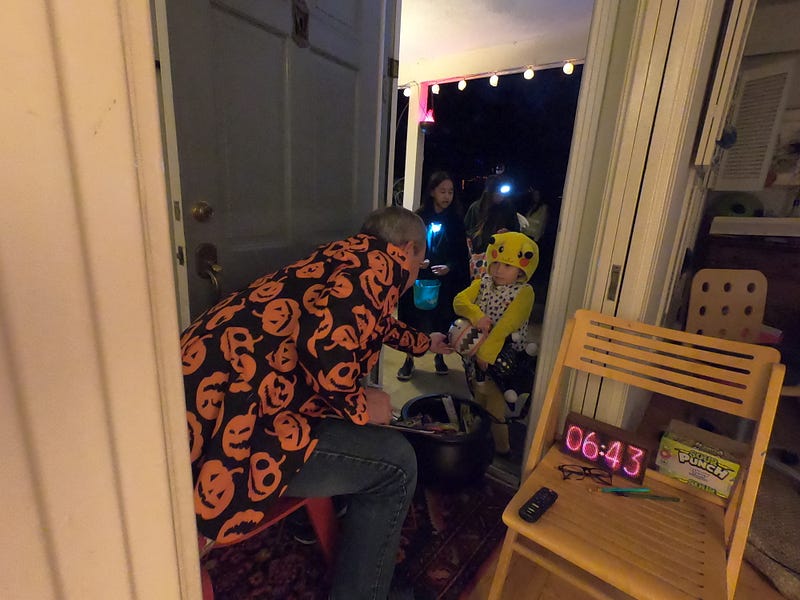
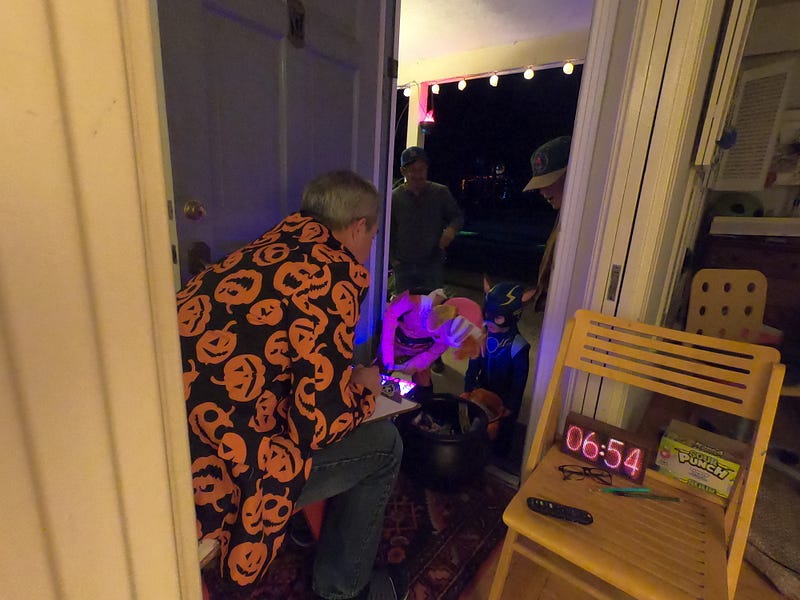
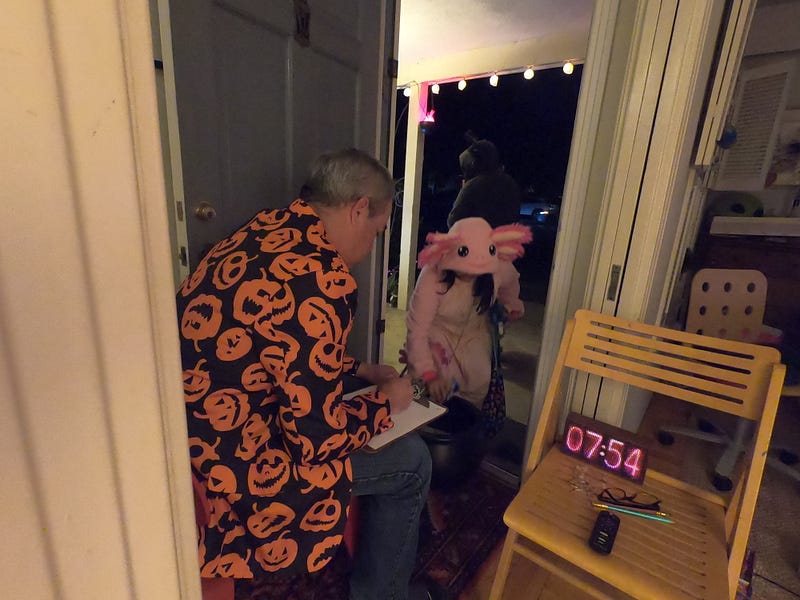
Pikachu, wearing a vest, carrying a doll as the candy bagTwo Mighty Pups from Paw Patrol choosing LED ringsTwo Axolotl choosing candyWinnie the Pooh & TiggerTwo Spidermen help finish out the evening
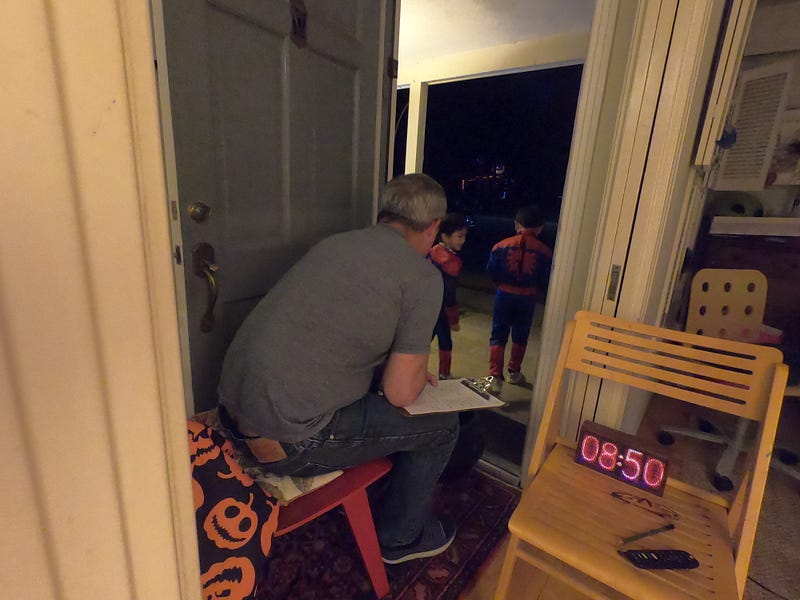
You can see the clipboard I use to write down what the kids tell me they are dressed as.
A drop in visitors this year. Seemed like a quieter night.
Spiderman, a perennial favorite. Wednesday maintaining a ranking from last year. I’m told Keeper of the Lost Cities is a popular book series.
This year’s complete costume list of 126 people:
3 “I don’t know” 1 Alien 1 Angel 1 Asha from Wish 1 Astronaut 2 Axolotl 1 Bam Bam 2 Batman 1 Black & White Rabbit 2 Butterfly 2 Cat 1 Cheetah 1 Chester the Cheetah 1 Chipmunk 1 Cobra Kai 1 Coraline 1 David Martinez 1 Deadpool 1 Demon 1 Dexter Morgan 2 Dinosaur 1 Dodgers Fan 1 Dolores 1 Dragon 1 Eileen & Rigby 1 Eric Cartman 1 Fireman 1 Freddy Krueger 1 Frog 1 Ghost Spider 3 Ghostface 1 Grandpa 1 Guy in Bandana 1 Gwen Stacey 1 Hermione 1 Hocus Pocus 2 In ‘n Out Person 2 Jack 1 Joy from Inside OUt 1 Juan Ramon 3 Keeper of the Lost Cities 1 Kiki from Kiki’s Delivery Service 1 Koala 1 Lara Croft 1 Magician 1 Mal from The Descendants 1 Max 1 Max from the Goofy Movie 1 Max the Goofy Dog 1 Michael Meyers 3 Mighty Pups — Paw Patrol 1 Miles Morales 3 Minion 2 Minnie Mouse 1 Mummy 1 Ninja 1 Person with lights 1 Pikachu 1 Pilot 1 Police 1 Princess 1 Princess Peach 1 Pumpkin 1 Pumpkin Grim Reaper 1 Raccoon 2 Robber 2 Sally 1 Scary Clown 3 Scream 1 Simon from The Chipmunks 4 Skeleton 1 Skunk 1 Snow White 1 Sorceress 5 Spiderman 1 Stay Puft Marshmallow Man 1 Superman 1 The Grinch 1 The Riddler 1 Tiger 1 Tigger 2 Troll 2 Unicorn 1 Vampire 4 Wednesday 1 Winnie the Pooh 3 Witch 1 Wizard 1 Wolf 1 Wybie from Coraline
My friend, Scott Watson, died six years ago in a plane crash.
There are some stories about Scott I wanted to share to highlight his genius.
I don’t know if anyone else will read this, but I felt the need to write this down before I forget or shuffle off this mortal coil myself.
Scott on the Playa
Scott and I met in 1995 when I first joined Disney. I was with the Disney Channel and Scott was with Imagineering and neither of us would stop talking about “the internet”. Scott had registered the domain disney.com and was scott@disney.com as a result.
We bonded over being tech geeks and sharing the love of making new things.
I explained how television technology worked and he explained much of the mysterious world of software to me. In the days before cybersecurity locked everything down we did stuff like setting up internal IRC servers on boxes running early linux distributions to chat during the workday.
There’s a few projects that Scott did that I’ll go into a little detail on. If you are not into the deep magic of the interwebs, it might not make a lot of sense. But I’m going to write it up anyways.
Go Radio
As the internet started to hit the news and get popular, audio streaming over the internet was a hot topic. At the time, to stream audio required a dedicated server running something like rtmp or the proprietary Realplayer server. Running these kind of servers was expensive and didn’t scale well.
The other new thing in the corporate world was caching images in a internet proxy server since internet bandwidth was expensive. The caching was extensive as most of the image assets were easy to track by site and filename and almost all internet access was via proxy servers.
We were bullshitting about “push technology” and other early web ideas when Scott had the idea about disguising audio files as images to get them cached in the proxy servers.
Disney had recently launched the ill fated Go.com portal and adding features to it was on the mind of Disney’s tech execs. After a bit of testing, Scott proposed Go Radio, which was a service on go.com to stream audio using mp3s (I think) disguised as image files so they’d be stored in enterprise proxy servers, reducing the bandwidth cost and eliminating the need for dedicated streaming servers.
And in the heady days of Web 1.0, Go Radio launched and was popular. We even were able to insert precious advertising spots to earn that filthy lucre.
Once the portal era and go.com evaporated, internet access to the companies expanded and newer streaming tech took over eliminated the need for Go Radio, but it was a wonderful hack that Scott came up with.
Interactive Monday Night Football
In the late nineties, I got involved with the first serious attempts to do interactive television. This holy grail of network television execs was to magically make money by people interacting with a broadcast television channel.
Web TV had launched and made a splash that had the TV execs salivating. For those that don’t know, Web TV was a small computer that used a television as a screen and phone line for internet access via an internal modem. It was a cheap way to get online, but several features were in a kind of walled garden arrangement, similar to AOL at the time. Microsoft bought Web TV soon after launch and it became a hot topic.
The TV engineers got together with a group of the nascent internet engineering community and formed the standards group ATVEF. I brought Scott along to the meetings, as my coding skills are non-existent.
In the older analog tv standard NTSC, there were specific “lines” in the signal format that allowed for transmission of digital data over the broadcast signal. TV engineers used these lines for sending triggers for broadcast gear, like the logos that pop up in the corner when you are watching a local TV station or test signals.
The idea at ATVEF was to have a standard for sending code via these lines that could be acted upon by devices that had TV tuners
Scott, as usual, came away energized and had big plans.
Scott helped build out a team that created a system to send out the interactive TV data to allow people to play games along with ABC’s Monday Night Football. He was able to convince the Disney/ABC execs to allow the data to be injected into the national ABC feed, the holiest of holys in broadcast terms.
While it was a limited audience of people who could see it, it was one of the first real uses of interactive TV. An amazing effort on the cutting edge of internet and television technology at the time.
Moviebeam
Scott was truly fascinated by the idea of sending digital data over the analog broadcast signal. “datacasting” was the term we used. Once he finished with interactive TV he had a new idea.
Believe it or not, in the time before widespread broadband, downloading an entire movie could take hours. Media companies were interested in ways to allow digital viewing besides DVDs. At the time, this was a hard problem to solve. “Fast” broadband at the time was a 3 Mb/s DSL line.
We discussed the issue a lot, despite many at Disney wanting the internet to go away.
Scott latched onto the idea of using the NTSC data streams to send movies to a device in the home. The transfer would be quite slow, but with a device listening 24 hours a day, it just might work.
And so Scott began on his quest to make Moviebeam happen.
The concept was caching movies on a box in someone’s home and when they wanted to watch it, they could purchase/rent it and it would unlock to be played. Kind of like a mini Redbox kiosk in your house.
He pitched the idea to the notorious Strategic Planning group at Disney and they greenlit it.
Soon, Scott was on trips to South Korea to coordinate with manufacturers on how to build set-top boxes that could listen to the on-air broadcast, store the data, and playback movies to a TV. I remember him trying to explain how easy it was to learn the Korean alphabet and read Korean.
Believe it or not, it all worked and I remember seeing the boxes in Best Buy. Again, an amazing technical achievement at the time.
Wrap-up
I’m not sure why I felt the need to write this. It’s been sitting in my mind for a while.
Scott was an inspiration to me and I think of him often.
I guess I just wanted more people to know what kind of special person he was and what we lost.
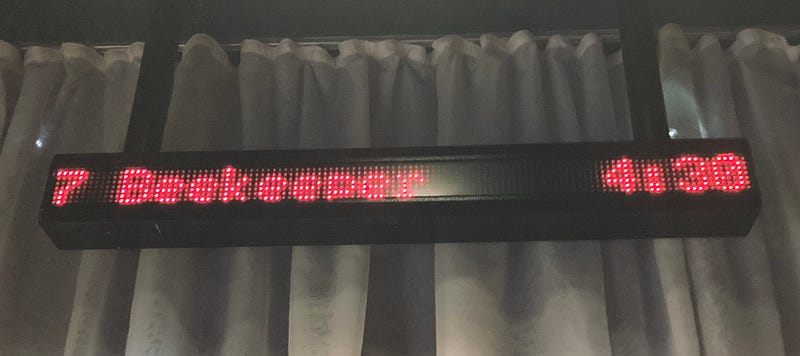
I am a beekeeper and went to go see The Beekeeper movie.
tl;dr: If you liked John Wick, go see it.
The early showing on opening day
Very much in the style of previous Jason Statham action films, the plot is just a device to take us from one fight scene to another.
The bad guys are flamboyant phone scammers and our hero goes after them with a calm determination. There are gaping plot holes, but no one in the theater will care.
Highlights include actual beekeeping scenes, a secret beekeeper lair, the surprise appearance of an Australian supervillain type, and a few bee puns.
Intertwined with the beekeeping, we have a FBI special agent tracking down our hero, with both a drinking problem of some sort, a hapless partner, and torn loyalties between “the law or justice”.
It’s a mindless popcorn movie, similar in many ways to the John Wick series.
I told my wife, Michele, that there needs to be a crossover between the Beekeeperverse and the Wickiverse and she said “There’s not enough ammo in the universe for that.”
But now onto the important stuff.
How was actual beekeeping portrayed in the movie?
Was it Hollywood nonsense, or was it accurate?
In short, pretty damn accurate.
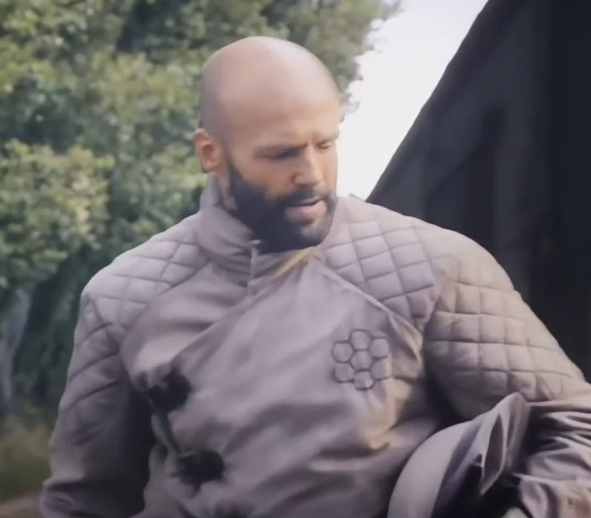
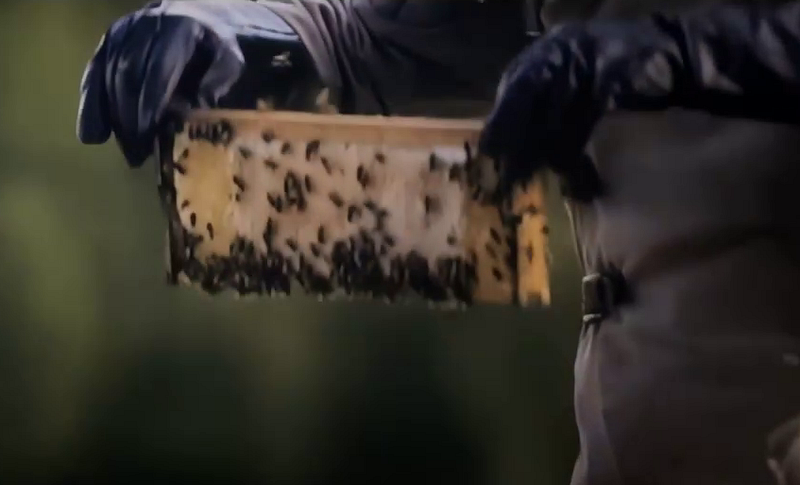
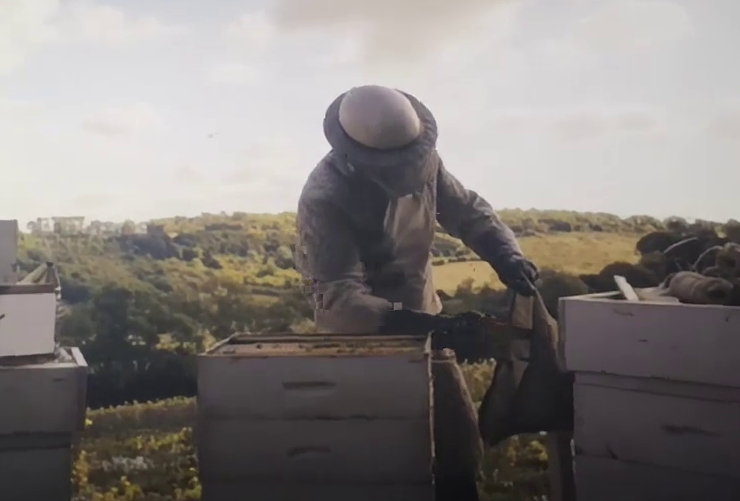
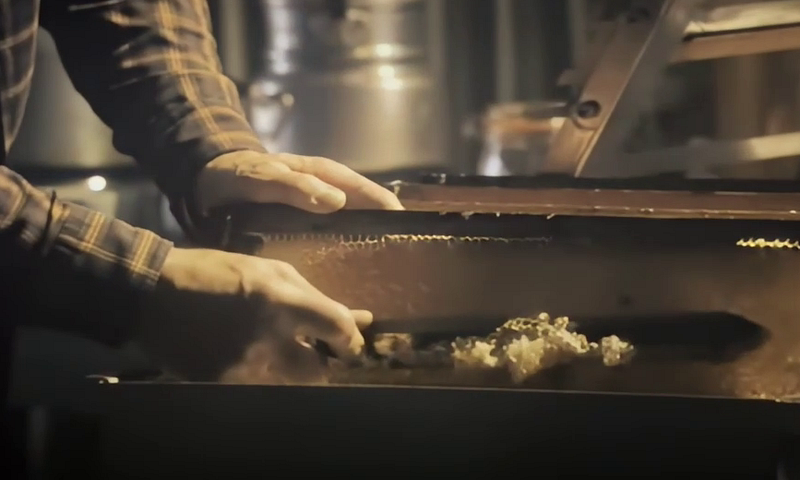
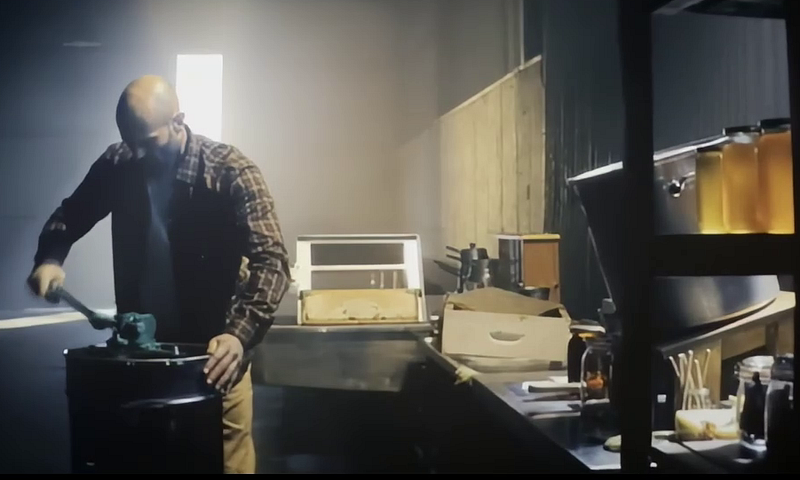
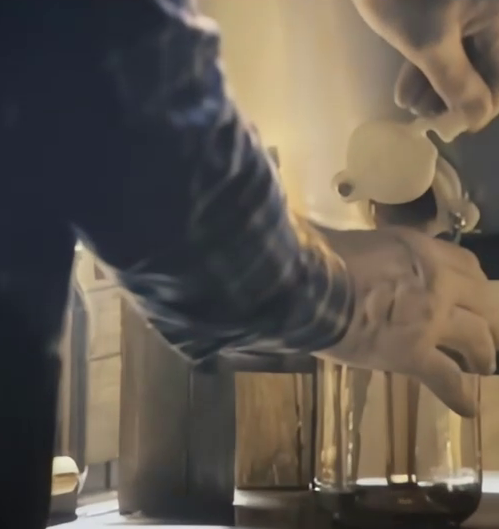
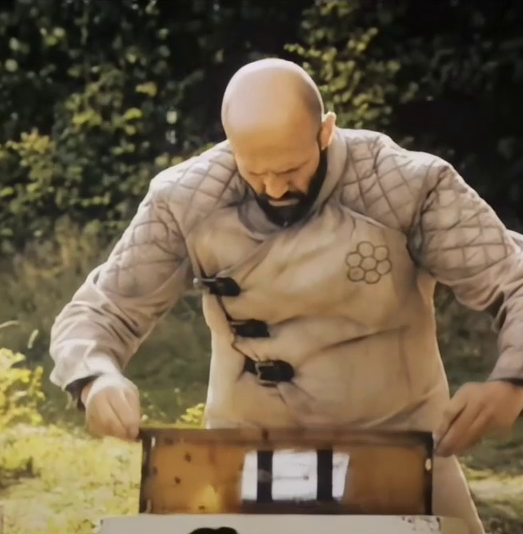
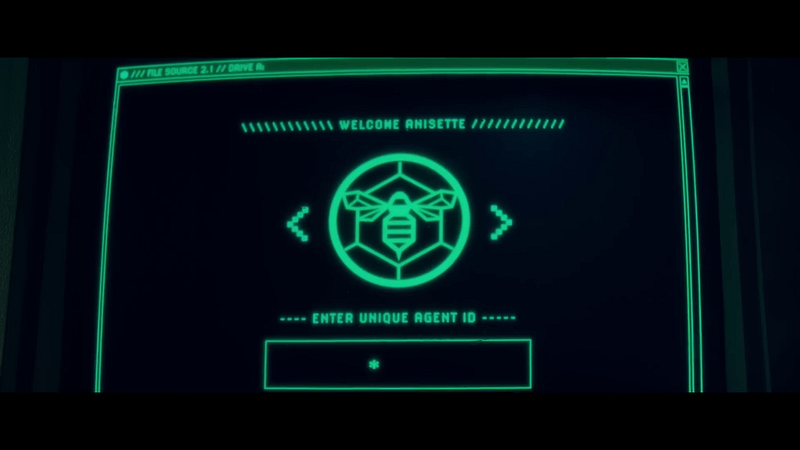
Our hero, beekeeper Adam Clay, wearing a unique jacket. Side clasps are quite unusual. Good to see him wearing full PPE, likely some spicy bees he’s dealing with. Appropriate use of smoke as well. Very accurate use of the j-tool to pull a frame from a honey super box. Doing a quick inspection. Even tilting into the sunlight for the best look. He does a textbook shake to get the ladies off a good looking frame of honey. Also uses a brush to clear the stubborn ones off. He places the honey frames in a bag, which I hadn’t seen done before. A real uncapping knife used to prep the frames for extraction. A manually cranked two frame extractor with lots of beekeeping gear on the worktable. Filling a large jar from the honey bucket, with the bucket on a tilted stand. Retrieving a Beekeeper comms device hidden in a hive box. Usually we find these covered in a lot of propolis and not so easy to remove. The typical login screen we Beekeepers see when regularly logging into the secret black ops system for wetwork assignments. Look like maybe one update behind the current software version.
The director did a great job of accurately portraying this part of beekeeping and I give it a thumbs up.
Hopefully in The Beekeeper II, we see our hero treating for varroa mites!
Over the last two years I had read about previous Hive Life conferences and how they were focused on hobbyist and sideliner beekeepers and encouraged a lot of social interaction. My experience at the California State Beekeepers Association meeting a year ago had soured me, as most of the conference was for commercial beekeepers and topics were focused on them.
When I heard about the NAHBE conference and the list of presenters, I decided to go, even though it was a plane trip away in Louisville, Kentucky.
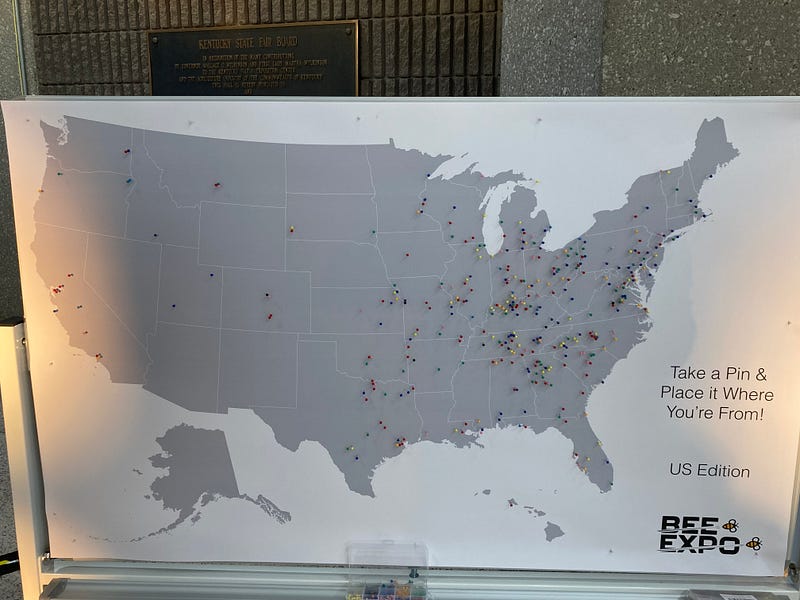
Attendee map of the US
I’m so happy I decided to go. The conference is well run and we were amazed at how quick everyone marched into the Expo, got badges, and were inside out of the cold.
Compared to all the other cons/conferences I’ve been to, this one was amazingly glitch free with no problems and a great setup. Kudos to the NAHBE team on fantastic organization.
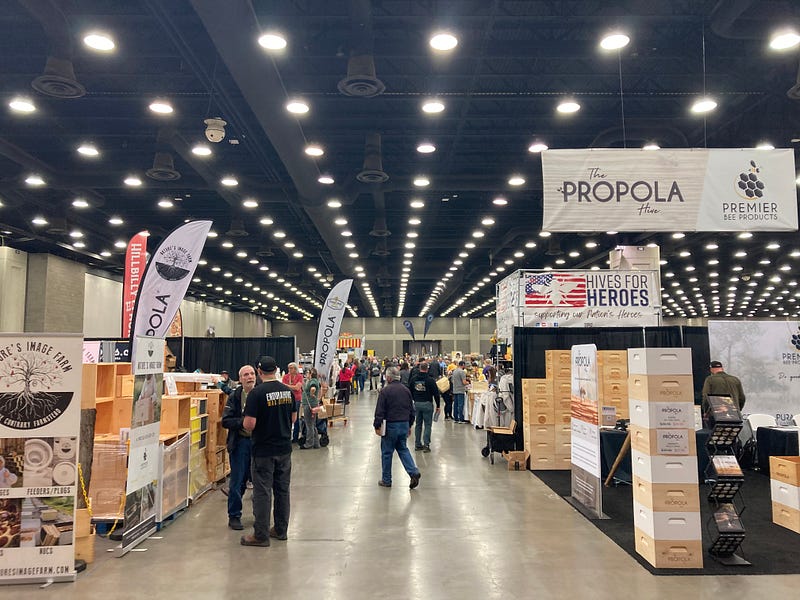
The trade show was impressive. There was not a big brand missing and many other companies I had never heard of had great stuff.
If you are a beekeeper, I seriously recommend you consider attending.
Conference was at the the Kentucky Expo Center — great facility
Here are my notes from the sessions I attended:
Day One at the North American Honey Bee Expo in Louisville, Kentucky.
The exhibitor floor is huge and we just scratched the surface of it. So many familiar names & brands there to look at and the ability to see how a lot of things actually work. There are demos of everything.
Went to the opening and first talk by Randy McCaffrey aka 628DirtRooster. Was mainly pictures and stories about cut-outs and all the notes and details he takes that don’t make it into his YouTube videos. I’ll have to do better with my cut-outs.
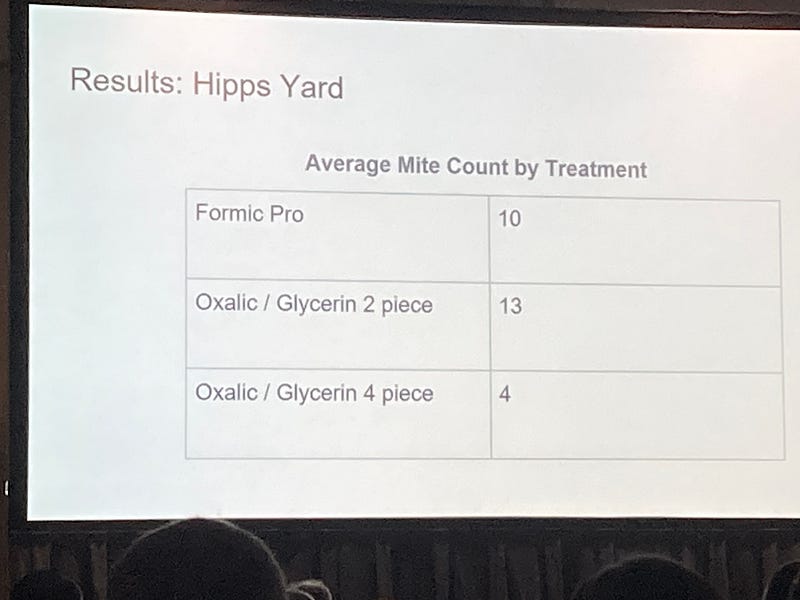
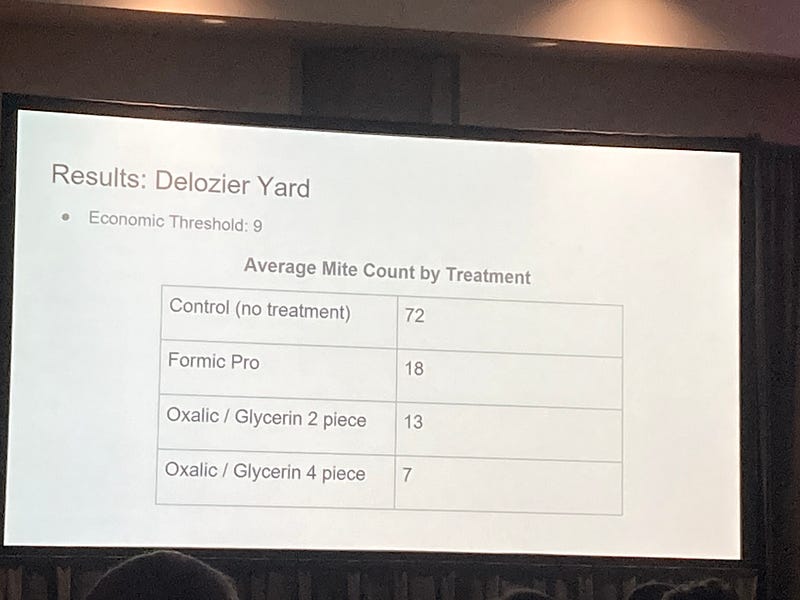
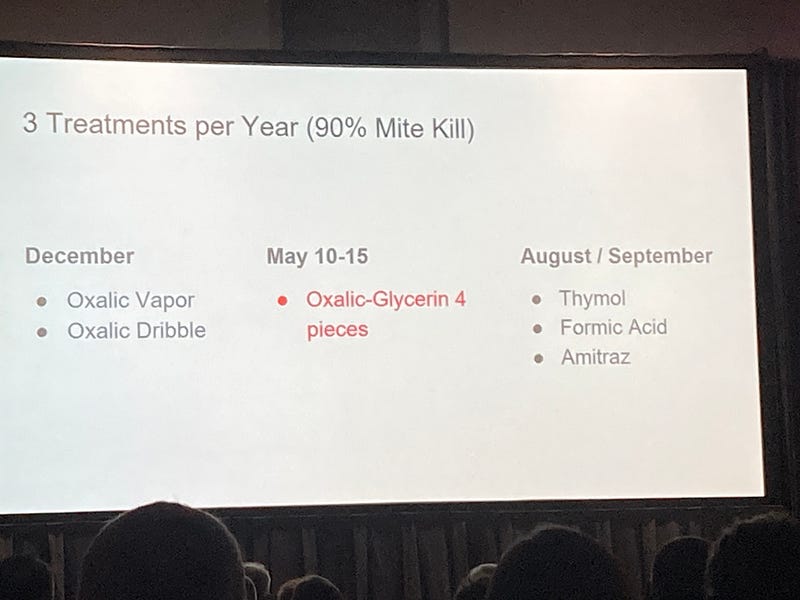
Greg Rogers talked about the Oxalic Acid Extended Release Field Trial he did last year in North Carolina.
In summary, the oxalic acid with glycerin on cellulose pads appears to work very well when you start with a low mite levels and will prevent significant rises in mite levels.
Comparing usage of extended release methods for varroa control Comparing usage of extended release methods for varroa control Recommended treatment plan based on experiment results
He stressed the key is starting with a low mite level. If you start with a high mite level, it will not reduce it.
The conference is perfect for hobbyists and sideliners. Everyone is excited and happy to chat with strangers. The vendors talk with everyone and there is tons to see and learn.
The vendor area was gigantic
Dinner in downtown Louisville was great with cocktails and amazing chicken, cornbread, hush puppies, etc.
Day Two at the North American Honey Bee Expo (NAHBE) in Louisville, Kentucky.
Dr. Marla Spivak talked about “Why care about propolis?”
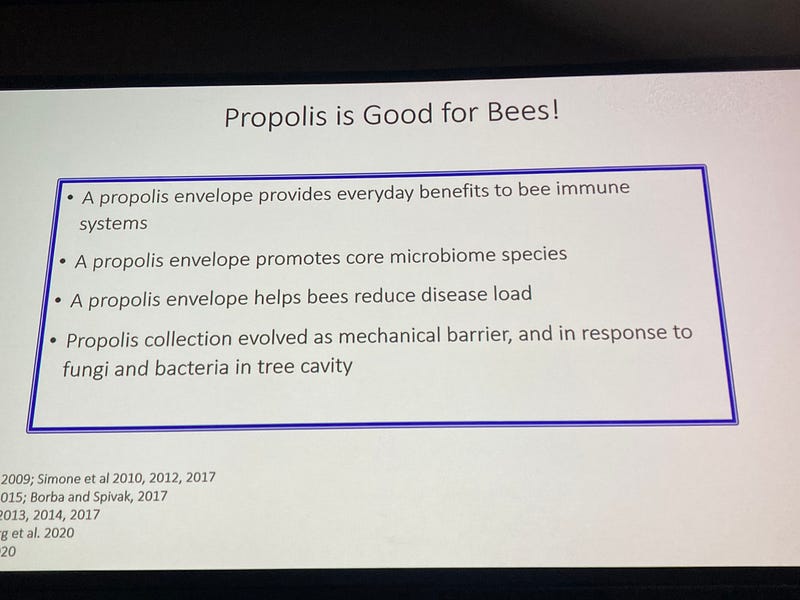
In short, a good propolis envelope significantly helps colony health and doesn’t affect honey production in strong hives.
Key takeaway on propolis
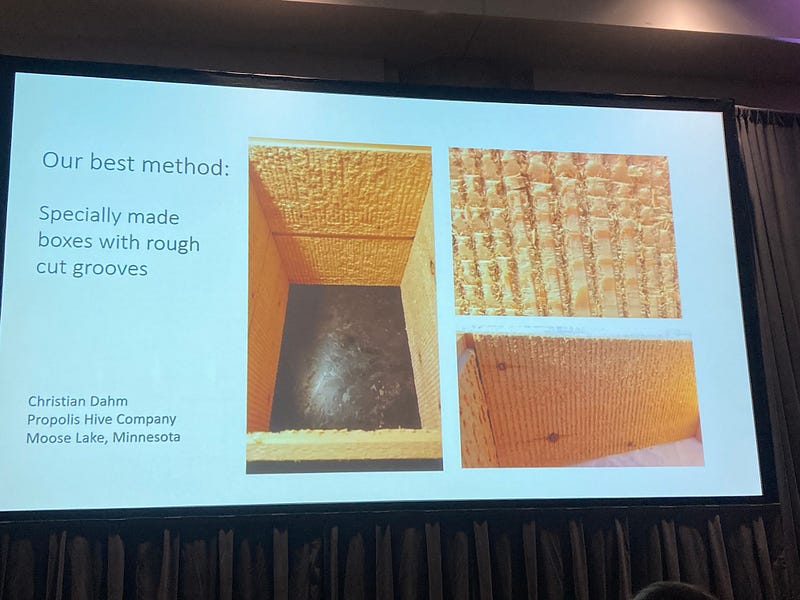
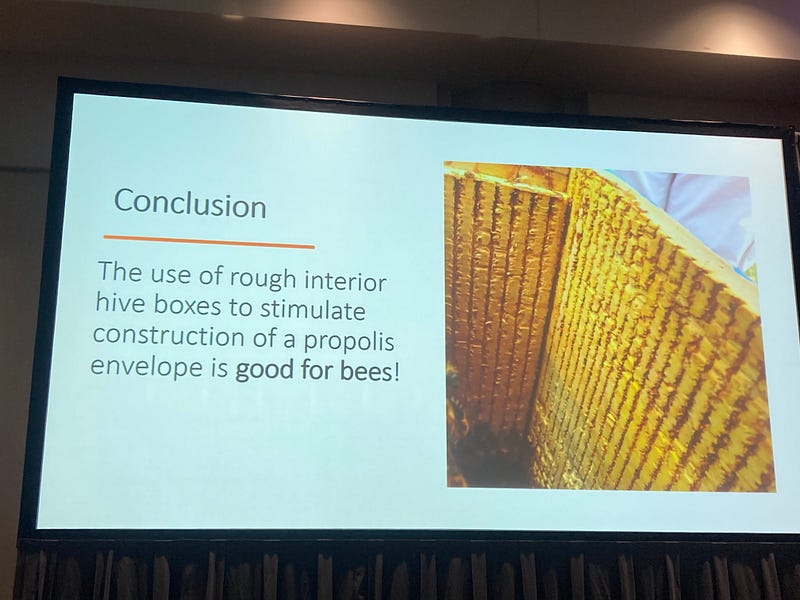
Use of rough box interiors was best for propolis envelope. Rough meaning seriously rough, with deep grooves, not simply scratched.
There are boxes coming on the market with varying levels of interior roughness.
The grooves the bees filled with propolis were seriously deep.
As far as human use of propolis, making tinctures from propolis is best when using 70%+ ethanol.
Dr. Cameron Jack spoke about “The Ins and Outs of using Oxalic Acid as a varroa control”
Started with reminders about safety and using respirators & eye protection.
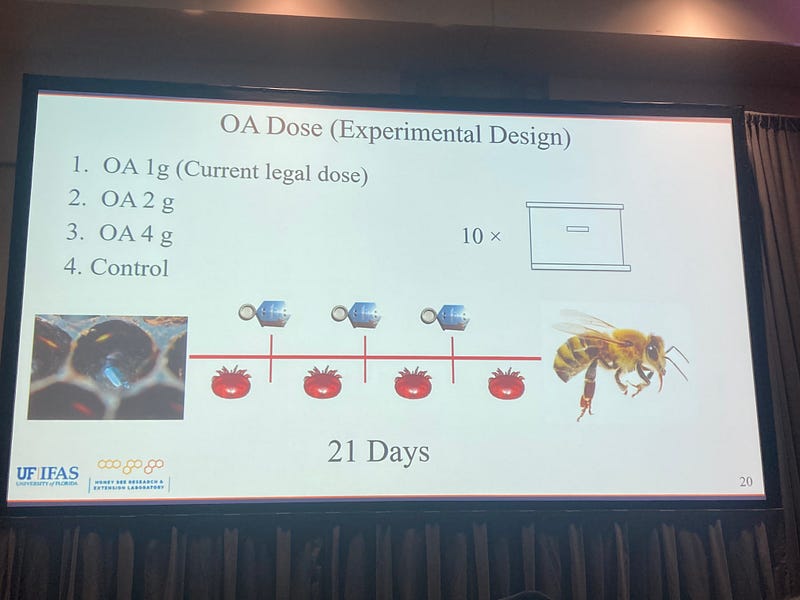
The legal versions are 1g per brood chamber, but testing with 1g didn’t show effectiveness. Many anectodal reports said higher doses are needed.
Testing methodology for Oxalic Acid Vaporization dosage
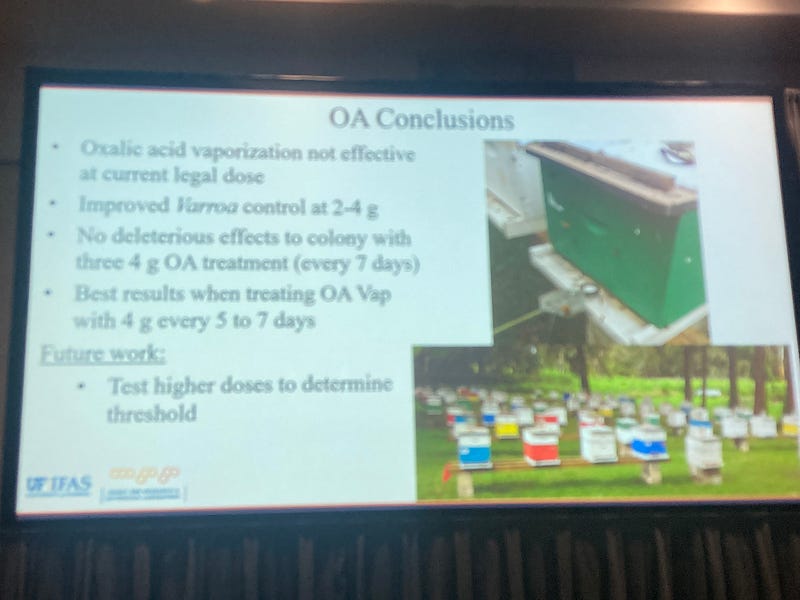
Experiments showed the 4g dose was optimal. No statistically significant impact on bees, brood, honey, or pollen.
Tested dribble vs. vapor vs. fogger and vaporization was most effective (using 4g dose).
Results comparing dosage methods
4 applications of 4g of OA vaporization in 5–7 day cycle is optimal. 10 minute hive seal up time is recommended.
Results comparing treatment timing
OA extended use pads appears to hold mite levels steady, but not reduce high mite levels.
No impacts on queens observed with OA use.
Final conclusions of the presentation
Work continues with the FDA for formal approval of vaporization use in higher doses and extended use pads, but progress is slow.
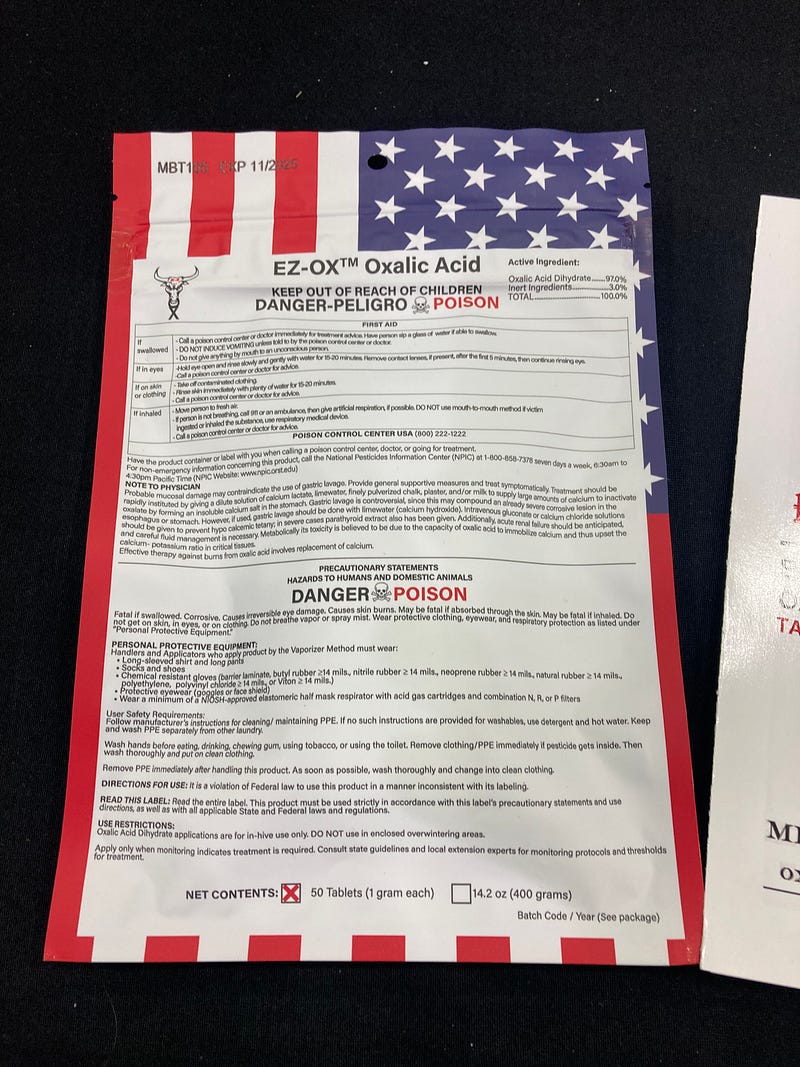
The new EZ-OZ oxalic acid pellets & powder are FDA approved for use at the 2g level, which is an example of the slow move forward.
Richard Noel spoke about “The Yellow Legged Hornet aka Asian Hornet”
Hornets stress the colonies to the point they cant fight varroa and then collapse. Hornets only directly attack deadouts or very weak hives.
Hornets depress entire local ecosystem by killing all insects they can find, not just bees. We saw scary videos of hornets “hawking” outside hives, hoving in front of entrances waiting to kill foragers.
There are several trapping tactics used. Spring traps capture founding queens which is optimal. Autumn traps also capture queens before winter.
When ground level nests are found, they are removed, but are huge. Nests high in trees are shot with pesticide paintballs.
Addressing the issue means involving the entire local community, just beekeepers isn’t enough.
Day Three at the North American Honey Bee Expo (NAHBE) in Louisville, Kentucky.
Natalee Summers spoke about Resource Hives
Basically putting in supplemental hives in the apiary to help have resources for production hives.
Michael Palmer calls them Brood Factories.
Typical resource hive set-up
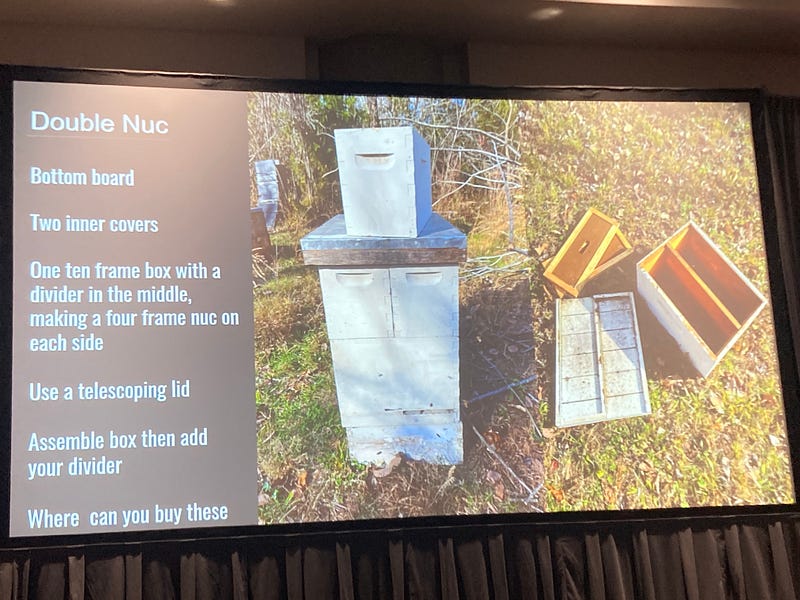
Typical setup is a double nuc box, 10 frame box with divider in the middle. HillCo makes them and calls them “Queen Castles”. Saw a few other box designs that could be used.
Typically start a resource hive by using a split. Swarms can also be used.
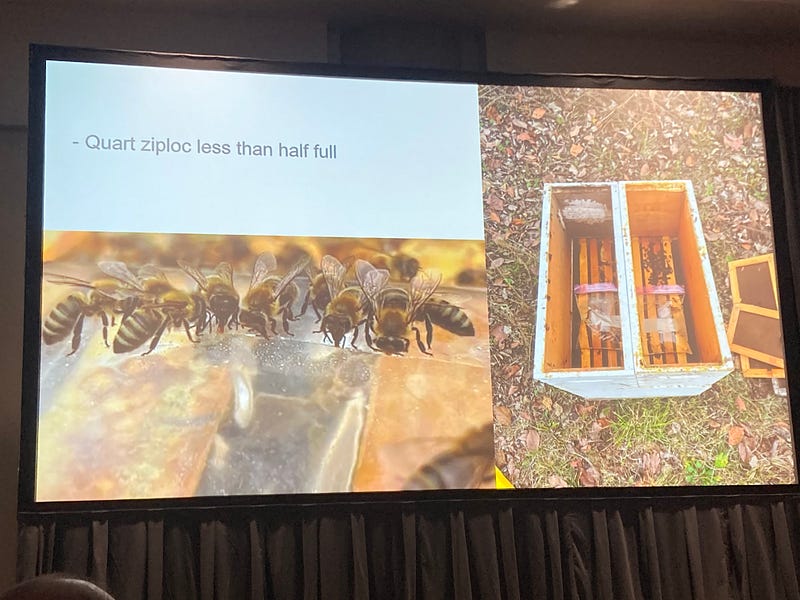
Showed a technique of feeding syrup from a quart sized Ziploc bag.
Using quart ziploc bags as syrup feeders in the nuc boxes
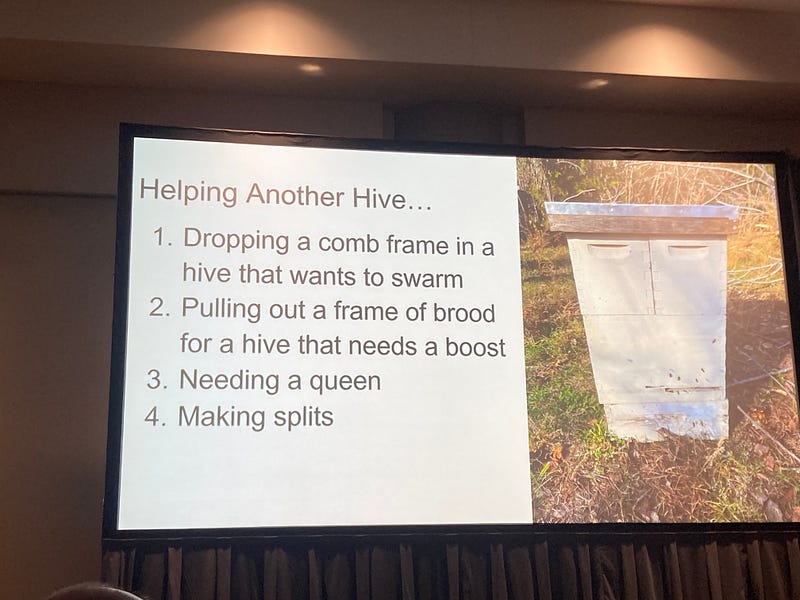
Being able to support production hives with frames of comb, brood, or even a queen is the goal.
Dr. Marla Spivak spoke on Social Immunity in Honey Bees
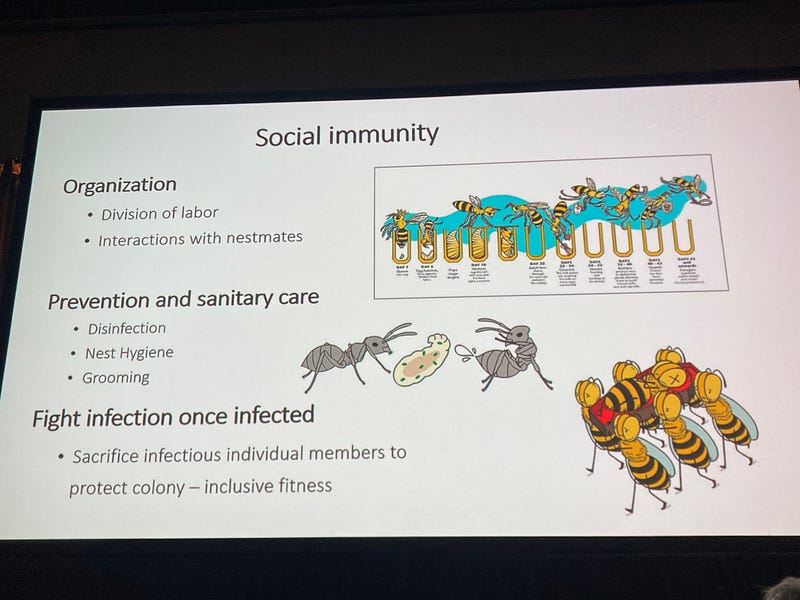
The talk was about the overall health of the colony and how it is helped.
How bees support the colony
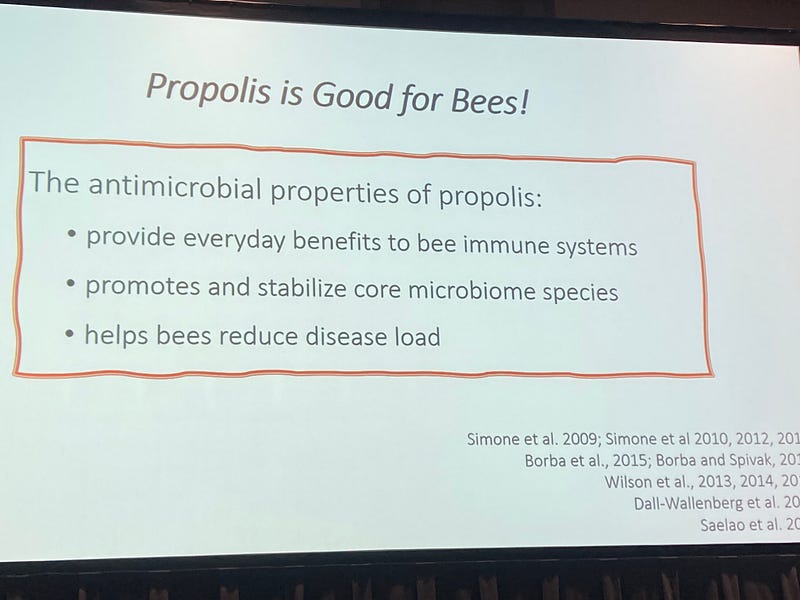
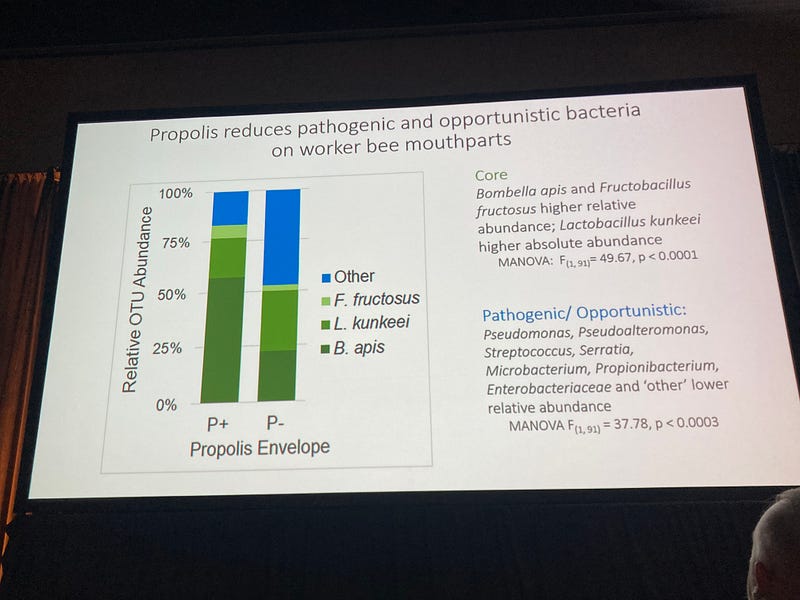
Propolis envelope lowers the overall disease load, prevents bacterial growth in food, and acts like an external immune system.
Propolis envelope has positive effects at microbial level
Beneficial bee bacteria appears to have some resistance to propolis.
Bees collect more propolis when colony is sick.
Propolis is a significant help to colony health
Experiments continue on hygienic behavior (removing sick larva from brood) and how determining how it is triggered.
The VSH/POL bee lines are shown to actively remove varroa infected brood. Evidently, bees detect mite infected cells AFTER egg laying has begun.
They open the cells to inspect and determine if the pupae needs to be removed.
The “selfie wall”
Overall, the NAHBE was a great experience.
Everyone was positive and engaged and wanted to talk beekeeping. No negative energy or politics.
Talking with vendors was informative and helpful. Saw a huge range of products and spent too much. Had to pack an extra duffle bag to carry everything home on my flight.
Kudos to Kamon & Laurel Reynolds and the entire team on a flawless event.
1. We give out full size candies 2. Make a listing of all costumes 3. Make a timelapse movie
I let the kids choose their favorite candy themselves. This can sometimes lead to a prolonged choosing process and debate. The moments of “OMG” and “wow” are wonderful as they realize the candies are full size.
Hearing the kids get excited about full size candies makes it all worth it.
I also gave out LED light up rings this year. They were a hit.
Kids would spend more time choosing a ring than candy.
When people come to the door, I ask every person what they were dressed as and wrote down their answers. I am careful to ask what they are, accepting their answers rather than interpreting what I see.
The time-lapse takes place over about two and a half hours that is reduced to just under 90 seconds for your viewing pleasure.
A few of the costumes I liked this year.
StrawberryTanjiro from Demon SlayerOogie Boogie from The Nightmare Before Christmas
You can see the clipboard I use to write down what the kids tell me they are dressed as.
A small drop in visitors this year. Didn’t quite get the crowds we have had in the past.
A bit of a change from last year with Dinosaur & Soccer Player topping the chart. A few of the costumes from TV & movies, but the usuals from the past not really making an impact. Only a couple Barbies, as I had expected more.
This year’s complete costume list of 149 people:
1 Alien 1 Alvin (Alvin & Chipmunks) 1 Angel 3 Avatar 1 Barbie 1 Batman 1 Bingo 2 Black Panther 1 Border Collie 2 Cat 1 Chester Cheetah 1 Cholo 1 Cinderella 1 Cinnamoroll 1 Clown 1 Construction Worker 1 Cool Black Outfit 1 Cop 1 Cowgirl 1 Cup of Noodles 1 Daft Punk 1 Damian from Mean Girls 1 Demon 4 Dinosaur 1 Doll 2 Elsa 1 Fairy 2 Fall Guy 1 Franchise 1 Ghost 1 Goose (fighter pilot) 1 Grim Reaper 1 Gymnastics Coach 1 Harley Quinn 1 Harry Potter 1 Hedgehog 1 Hello Kitty 1 Helper 1 Her Dad 1 Hit by Truck 1 Hogwarts Student 1 Iron Man 1 Isabella 1 IT 1 Itachi 1 Jake 1 Jason Voorhees 1 Katrina 1 Kazuko from Demon Slayer 1 Ketchup 1 Killer Lumberjack 1 Koala 1 Kuromi 1 L from Deathnote 1 Lebron 1 LED Man 1 Light from Deathnote 1 Link 1 Lisa from Deathnote 2 Luigi 1 Mad Hatter 1 Mad Scientist 1 Magician 1 Maid 2 Mandolorian 1 Mario 1 Marshmellow 1 Maverick (fight pilot) 2 Michael Meyers 1 Minecraft 1 Mira 1 Netsuke 1 Ninja 1 OC 1 Oogie Boogie 2 Orange Girl 2 Penguin 1 Poison Ivy 1 Pompompurin 2 Princess 1 Pummy 1 Quincy Morris 1 Rake 1 Robber 1 Ronaldo 1 Sally 1 Sarah Sanderson from Hocus Pocus 1 Scary Person 1 Scream 1 Secuna 1 Shinoda 1 Simon (Alvin & Chipmunks) 2 Skeleton 1 Skeleton 1 Skull 1 Snow White 4 Soccer Player 1 Softball Player 1 Sonic the Hedgehog 1 Soulja Boy 2 Spiderman 1 Spiderwoman 1 Stick Man Figure 1 Stitch 1 Strawberry 2 Tanjiro from Demon Slayer 3 Teenage Mutant Ninja Turtle 1 Teenager 1 The Hulk 1 The Purge 1 Theodure (Alvin & Chipmunks) 1 Tree 1 Trillionaire 1 Undercover Vampire 2 Unicorn 1 V 1 Vampira 1 Vampire 3 Wednesday 3 Witch 1 Woody
For the last few years, I had several thousand people at my disposal, part of a global group, operating 24/7 that would do my bidding. A simple post on Slack or a brief voice chat was enough to hurl them into action, ready to spend hours warring against our foes. Various teams coordinated our real and virtual infrastructure, the military led our battles, and my diplomats dealt with the incoming drama.
In short, I was a Warlord in the ur-Metaverse.
My path led from the earliest days of computing, where my father, an electrical engineer, first started me programming Lunar Lander on an red LED HP calculator. Soon the arrival of home computing and a 300 baud modem put me “online” for the first time navigating the world of BBSes and online communities of the early 80s.
As computers and internet bandwidth advanced, the opportunities to interact with others exploded with the first LAN based groups and in-person LAN parties. I started playing Ultima Online (UO) in 1997, one of the first MMORPGs, watching as the first guilds and clans formed, creating bonds from all over the globe, the first virtual tribes.
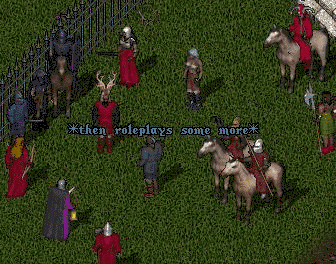
Ultima Online, circa 2000
Soon online gaming went mainstream, exploding onto the internet with first person shooters, real-time strategy, and more MMOs hitting cyberspace allowing interaction of people not limited to a LAN party.
Around the same time in meatspace, I became an tech exec in a big media company and began learning the hard lessons of leadership, especially those of when leading a technical staff. Managing technical people is much more than being good at technology, it’s about learning how to listen and understanding people’s motivations.
As a technical person myself, it was often a struggle to manage my own internal drive to be the person with all the answers as opposed to letting my team make decisions and act without micromanagement. This is a widespread struggle in both business tech work and gaming communities. The desire to be RIGHT and OPTIMAL.
The late 90s and early 2000s were transformational in how technology was managed and coordinated in businesses. No longer the quiet occupation of unseen nerds in the background, technology and interconnectivity became center stage of the business world along with transforming our concepts of community.
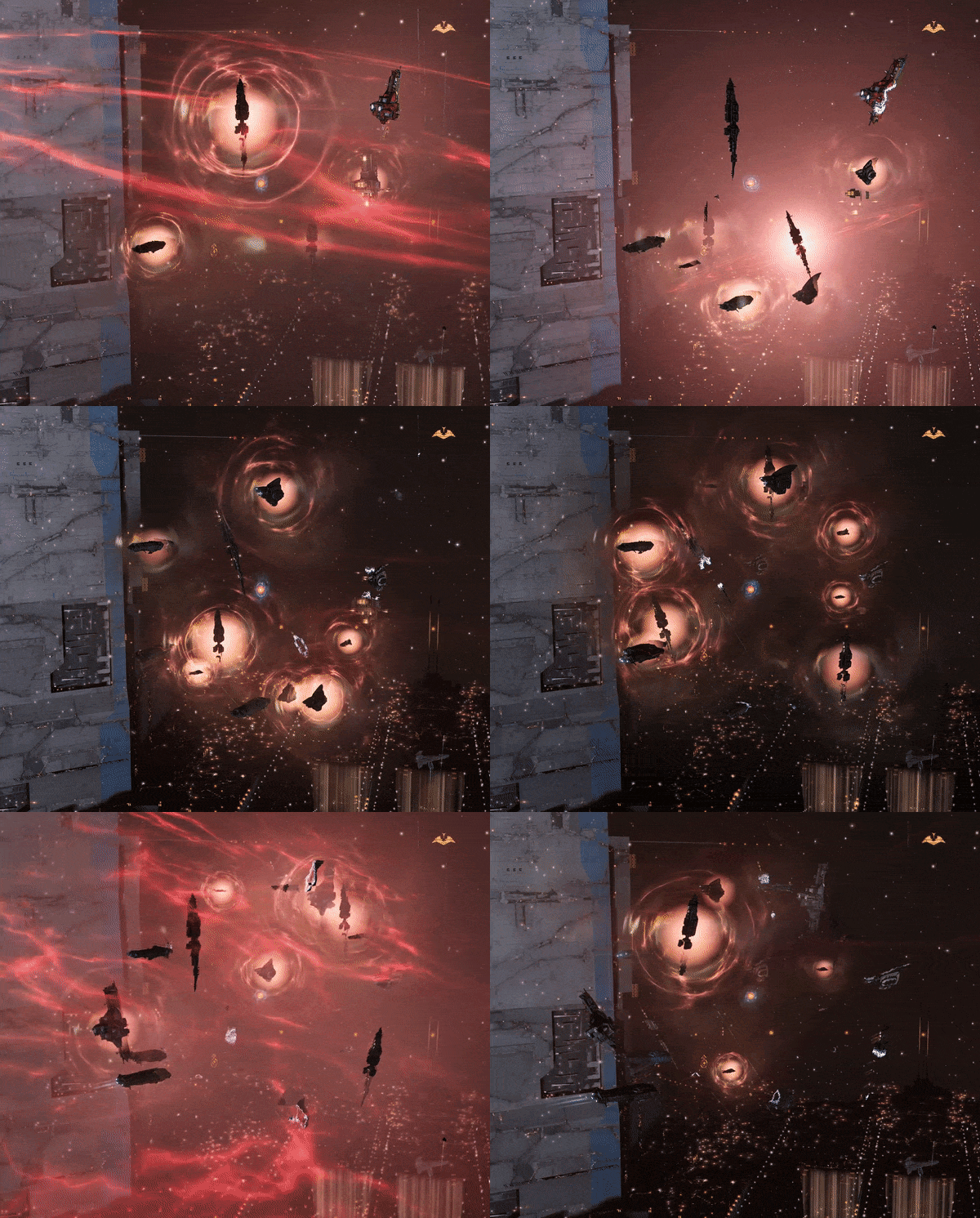
In 2008, I started playing EVE Online, which hit a sweet spot in my brain, creating the kind of dopamine flow that all gamers crave.
A spaceship fleet in EVE arrives home
EVE is more of a galaxy space simulator than a game. The Icelandic creators envisioned a brutally harsh universe, where Death is a Serious Matter, and the Strong impose their will upon the Weak.
People playing EVE did what humans always do. They formed groups to protect themselves from the Others and rapidly innovated tactics to gain even the slightest edge over them.
In EVE, players can control star systems in a virtual galaxy where nearly everything is built by the players. A complex economy that required players to literally do everything from mining asteroids for metal to refine ore to build spaceships and the equipment to fit them. Even the ammo to load weapons was player built.
The player groups organized seriously, in the form of Corporations which congealed into formal Alliances to better manage the numbers joining the ranks and coordinate efforts. Rapidly it became de rigueur to have an IT backbone of real meatspace servers to rely upon for communication purposes. Spy networks formed to gather intel on opponents, and of course counter-intelligence teams worked to foil them and use professional forensic techniques to hunt the spies.
The leadership of groups in EVE is almost exclusively by (mostly) benevolent dictators. Groups have tried space democracy, but it has failed repeatedly. What empirically works is a leader with complete authority making decisions. In the game, they are referred to as CEOs, but they are in fact, warlords, maintaining fiefdoms and commanding their forces to attack or defend as needed.
In 2013, I became more deeply involved with one of the newly formed groups, helping in a small way to launch the group, but mainly being a line member, meaning I had no real responsibilities to the group.
The rigor and complexity in the game for building spaceships and other items was relaxing in a strange way to me and provided a benefit to the group, as I was willing to do this “space work”. As time passed, the group’s trust in me grew and I did more and more space work on behalf of the corporation.
Having been an early blogger, I leaned into this and started writing commentary on the game and its design. First for other EVE news sites and eventually on my own site. I appeared on various podcasts and Twitch streams, becoming a nano-celebrity.
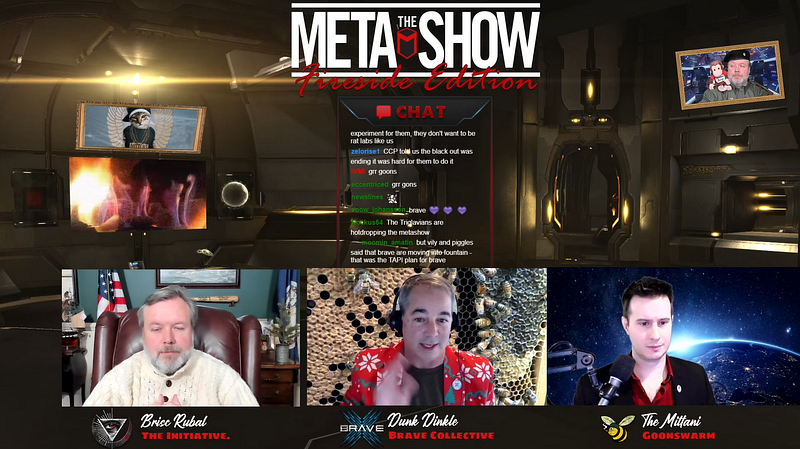
EVE Online talk show on Twitch
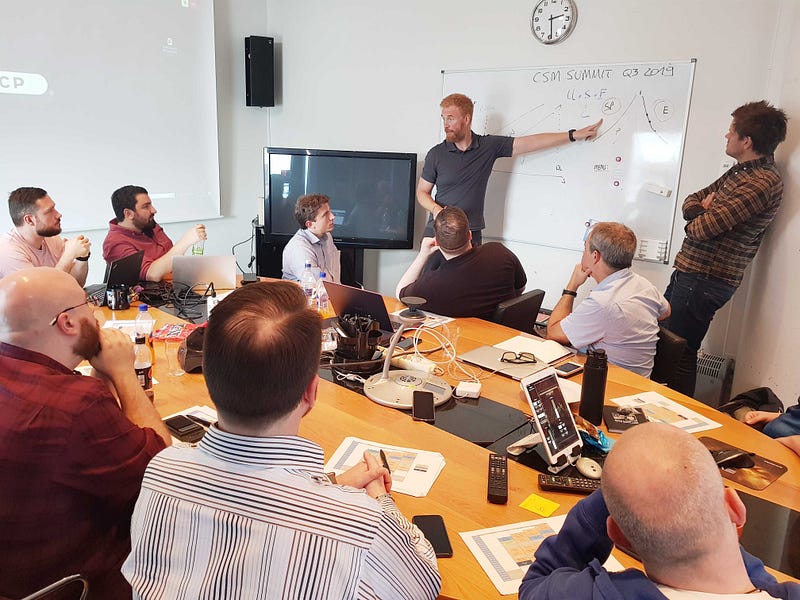
I gave talks about leadership at a couple of the player conferences (2018, 2019) while at the same time making videos for my own group’s internal consumption. Much of this drew on my own experience managing a corporate staff, negotiating with stakeholders, and methods to communicate ideas to maintain morale.
CCP CEO, Hilmar Veigar Pétursson, discusses EVE w/ the CSM advisory group
All of this eventually led up to being elected to the Council of Stellar Management (CSM). The CSM is an advisory group for the game designers and I was flown to Reykjavik, Iceland for basically a week of business meetings about the game. More and more people in the game knew my name and my reputation.
My role in our group continued to expand as I was given more and more authority and responsibility to handle day to day issues. I pushed a lot on the culture of our group, repeating our slogans, almost like a mantra.
Stay Classy. Have Fun. Be Brave.
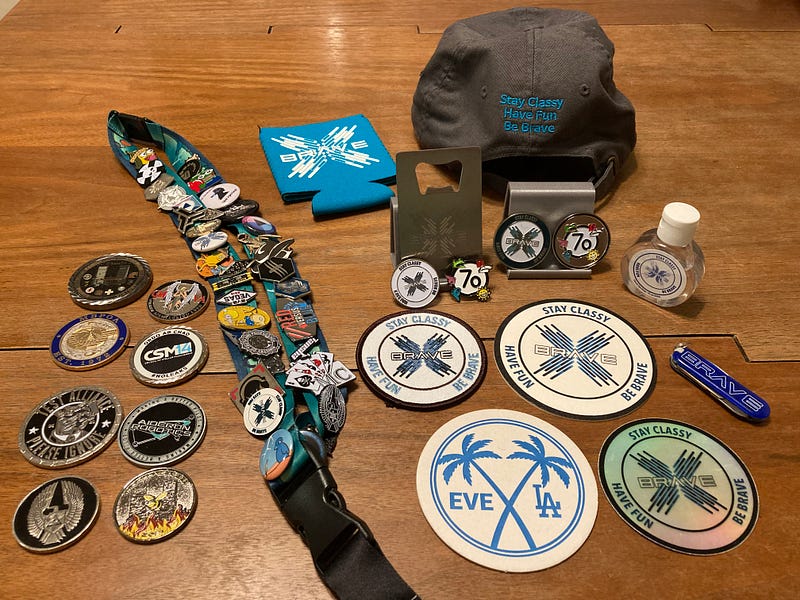
Some of the morale items for my group and others given to me by other groups.
Keeping the group culture cohesive and aligned was more important than any in-game goal. Group morale and cohesion is critical for any grouping of humans, especially online.
My notoriety grew until during one of the galaxy spanning wars between players, I was put in charge of our group, becoming the CEO of the alliance. This was a big change to my experience, as I was now managing several thousand people across the globe to achieve specific goals. I spoke about it at one of the EVE player gatherings, known as Fanfest in Reykjavik, Iceland.
The group was in many cases better organized and managed than most meatspace companies with division of labor, rules, guidelines, and strict accountability for personal actions. The hypercomplicated nature of EVE gives way to specialized software and endless spreadsheets needing to be updated and modified. With motivation in the metaverse not being based on financial reward, but on esprit de corps and social reputation, people would spend hours each day working to help achieve large goals for the group.
This kind of social currency and sense of achievement is highly motivational to people. It doesn’t matter who you are in the “real world”. Whether you are a corporate attorney, a construction worker, a truck driver, or a soldier has no bearing on how you are viewed by others. It doesn’t matter if you’re gay, straight, trans, or otherkin, all that matters is what you DO in the game.
This is tremendously freeing to many people that struggle with fitting into their small town, or people not understanding their autistic tendencies, or those that aren’t recognized IRL for their skills and abilities. Being able to disconnect your virtual life from your real life is essential for these kinds of metaverses to exist and grow.
I can’t stress enough how important it is for people to be able to live this virtual life to find some solace in a real world of stress, polarization, and difficulty. It is the core of what the metaverses are about.
EVE has traditions and rituals just as powerful as any found elsewhere in life. When a person dies, a vigil is held when ships light cynos, analogous to lighting a candle, in their honor. For these vigils, war is put aside and safe passage is given to others to join in the vigil, even between sworn enemies. Kind of like the fabled Christmas soccer game in World War I.
Lighting cynos and fireworks to remember the dead
Large space stations often have naming ceremonies where speeches are given and dedicated as remembrances of past events or people. This is when I gave a short dedication in honor of the mother of a player that had died to suicide. We still hold a yearly vigil to remind people of him and the need to let others know if you need help.
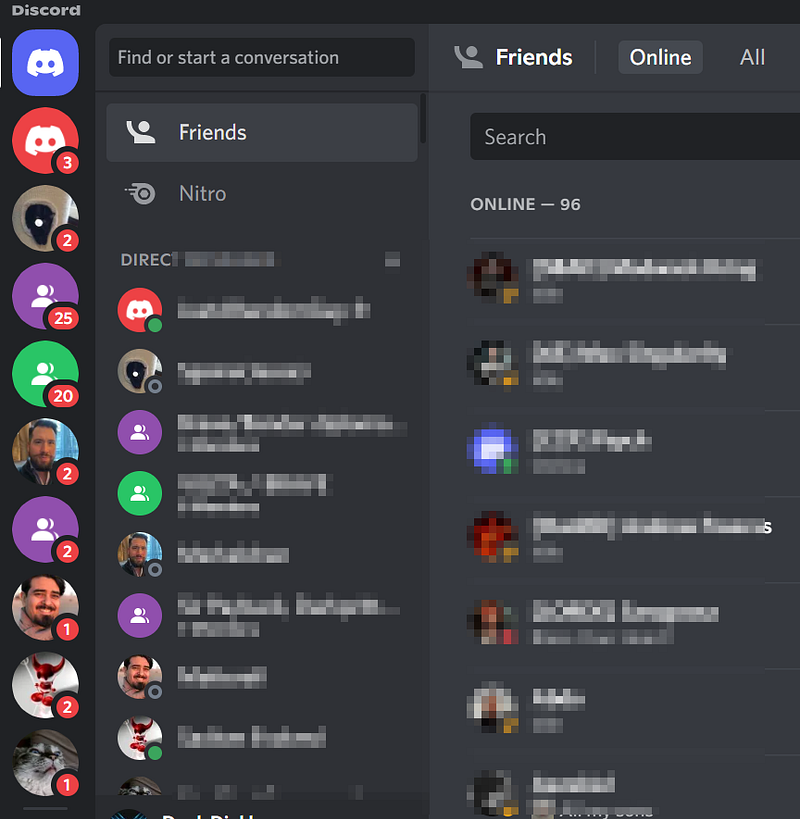
My role as CEO was all encompassing. Both the minutiae and the complicated filled my Slack and Discord DMs constantly. The delicate metagame of diplomacy with other warlord leaders was conducted secretly, and required immediate attention to handle crises that popped up all too frequently.
Continuous DMs for issues morning & night
My fellow warlords ran the gamut from the Italian neuroscientist to the Canadian military officer to the retired Washington D.C. attorney to the British motion graphics designer to the Singaporean businessman, each with a wide variety of styles and management styles. Working with them was similar to my professional work, dealing with creatives, finance, and other corporate types, adjusting my approach to each individual.
Almost daily, the typical interpersonal issues that pop up anytime humans gather would arrive on my plate. Most complex was navigating the myriad of relationships and rivalries between leaders that in many cases went back decades. Pacts and agreements were memorialized in formal documents as precise and finely tweaked as any legal agreement. In many cases, actual attorneys reviewed proposed agreements to look for loopholes and language that could bite us later.
At one point, we lost a war that had been going on for over a year and I had to give a speech telling my group we had lost. I spoke as honestly as I could to my people about the situation. I was surprised to find my honesty in such sharp contrast to what was said by other leaders on the losing side. This talk was well regarded on all sides and gave me a huge amount of credibility in the game, far more than I expected. Honesty from a leader is all important, not just to your group, but to everyone that you deal with.
Besides the power of our groups, many of these agreements were dependent on the personal credibility of the leaders to keep their word and not backstab others. I had built a strong reputation and was able to cut deals on behalf of it as a result. Again, no different than a corporate boardroom or in politics.
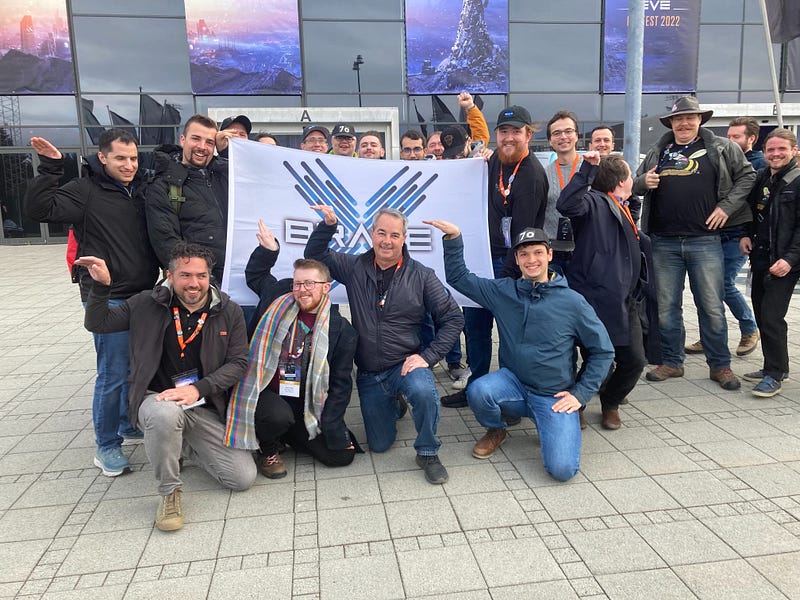
While our group was vast, spanning the continents and time zones, the larger community of EVE players was even larger. At gatherings in meatspace, in-game rivalries forgotten and the warmth of being with people who grokked your love of EVE was palpable.
Of course, these kind meetings also led to discussions of game politics, direction, and the future of the game. At these events, wars were instigated, stories were told, conspiracies hatched, and fences mended, much like anyplace else that humans gather in groups.
The comradery of players is intense. Retelling the war stories of the past between former enemies are commonplace, with toasts, laughs, and often hugs between those involved in storied battles or events.
At a player gathering in Reykjavik, Iceland
As a well known person and leader in the game, when I would attend gatherings, there were a lot of people that would want to talk to me. My nano-celebrity preceded me and there is a bit of a parasocial relationship that happens. People knew a lot about me. They had been in my dining room from watching my videos. They knew my hobbies and would ask about my beekeeping. But for many, I only knew them as a name on the screen or maybe a voice in comms. I would know next to nothing about many of these people, but they knew a tremendous amount about me.
As an extroverted type, this didn’t bother me. I like talking to people. But each person wanted to have a real interaction, not just a selfie. So I put a lot of effort into talking with people, asking about their experiences and life in the game. I wanted to make them feel noticed and just as interesting as they felt I was. Not always the easiest task, but it is critical for leaders to show respect and interest in people that look up to them.
Respect needs to be symmetrical, which is not always easy in these parasocial relationships. I usually carried a bunch of small items with my group’s logo like a bottle opener, beer koozie, or challenge coin. Handing these out to people was a sign of respect toward them and made the time a little more special.
There were times it was difficult at gatherings, when I was talking with one person already or with my wife, when someone would interrupt. Trying to balance things in those situations to make everyone feel that they weren’t being excluded wasn’t easy. I can’t imagine what true celebrity status must be like.
This community, with the realm of the EVE simulation, is a metaverse.
Far from the ideas of Silicon Valley and their fantasies of monetization and business meetings, this is an actual example of the alternate life with cyberspace that will be what the actual metaverse will be like to people.
A place to escape whatever bothers IRL.
A place to achieve.
A place to be who they aspire to be.
For myself, I enjoy being a leader. I have little fear of speaking to groups or revealing my feelings to others. I have learned to listen and am better for it. There is a special feeling of true leadership in which you are able to inspire others, not by fear, but by setting an example, however imperfect.
I loved making self-effacing videos to message the group our goals and ideals. I spent a silly amount on items with our logo and slogan to give away at RL events. Seeing the joy and pride in handing these items to others and seeing their genuine happiness is only overmatched by the joy of giving gifts to my own daughters. Everyone wants to be appreciated and these small tokens like a small payback for the faith placed in me as leader.
I couldn’t imagine it ending, until it did.
The last few years, I had suffered through increasingly worse headaches and stress. My work involved a lot of effort to maintain operations during the pandemic. Editing video and making graphics on the scale that a modern media company is difficult in normal times. During the pandemic, it took almost everything I had to convert the infrastructure to remote work and maintain it. I wrote a bit about it here.
Finding myself waking every morning to a slew of issues to deal with in EVE, spending a long day in the office, and then dealing with more EVE in the evening was a huge amount of work.
My fun per hour was low and EVE felt like a job on many days. I still found it rewarding, but it was taking its toll, my second job in the metaverse. Even when I was on vacation from work, I was still on duty with EVE, managing things from hotel rooms and beach houses instead of relaxing.
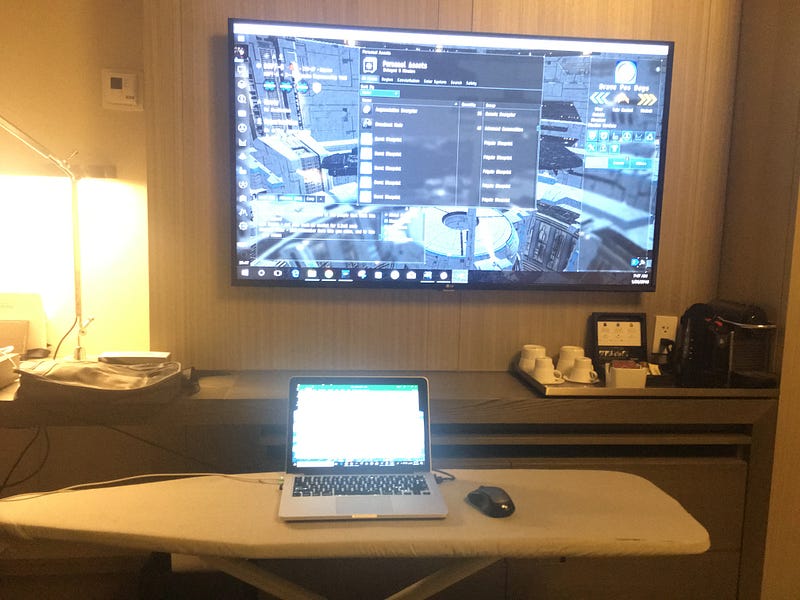
Logging into EVE from a hotel room
But the intoxicating feeling of leadership, when hundreds or thousands of people are acting upon your words and rallying to your virtual flag is hard to walk away from.
After a year of no relief from constant headaches, a university ‘ortho-facial pain clinic’ was able to finally diagnose what was causing my headaches. A prescription of anti-migraine medicine combined with removing a couple of molars that were causing complicate jaw and sinus issues and I was starting to recover, but the doctors kept telling me that stress was a big factor and I had to do what I could to limit that.
I had previously chosen a successor to myself for the group, just in case. A person that embodied the same ideals and desires for our group that I did. A brilliant and humble NASA scientist who also had been with the group since its inception. It was time to turn the reins over and walk away. This could be no half measure.
So I gave a short speech announcing my decision to stop playing and hand leadership to another. The talk was difficult to get through and I still get verklempt thinking of it. But it freed me from the weight of leadership and the stress of constant drama.
As I write this, it’s about six months from when I stopped and can finally look back.
I do miss the people terribly, but do enjoy the freedom to do other things. The freedom to not need to turn on my computer for space work. The freedom to not have to meet the expectations of others.
Michele, my wife, is thrilled that I closed that chapter of my life, freeing myself to be more present and find time for other things in life.
There is no doubt that I will fall into another community metaverse at some point and possibly lead again somewhere. Michele says “You are built for this.” when I talk about leadership, stressing that it comes naturally to me, unlike many others.
The last few years have had the tech media talking about the metaverse as if it’s a product to be invented. They are so off-base that they can’t see that it’s already begun, without fancy VR goggles and without slide decks.
The metaverse(s) yet to come will spring up more organically and around common interests, tied together with ever increasingly powerful tech to allow global communities to form and work together. Video games are the most natural ground for these kinds of groups to form, as teamwork and mastery are keys to success in gaming.
Teamwork and mastery are key motivators for humans. When people feel they are accountable to their friends, they will go far above normal effort to get things done.
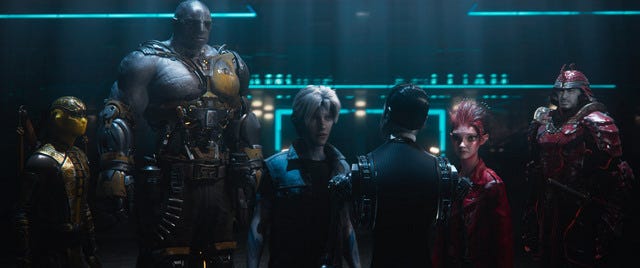
While imperfect, the book/movie Ready Player One captured a lot of the basics in the power of mastery and the ability to gather others to a cause. The corporation in the story is the villain, much as corporations are often the villains in meatspace. The escapism of a metaverse community and the ability to be another person in it is the critical aspect that many fail to understand.
Other new technology and concepts are floating in the metadiscussion, many of them get rich schemes based on NFTs and crypto arbitrage, but there are glimmers of helpful tech for the metaverses like DAOs and smart contracts, that might enable new capabilities and structures hitherto unknown.
There are other metaverse warlords, like me, out there already. Carving out virtual fiefdoms and personal armies, doing things both good and bad, across the globe. They may not seem obvious or popular as those in the current ‘cult of the influencer’ zeitgeist, but their day is coming. The metaverse is sneaking up on humanity where the pundits least expect it.
As William Gibson said, “The future is already here — it’s just not evenly distributed.”
1. We give out full size candies 2. Make a listing of all costumes 3. Make a timelapse movie
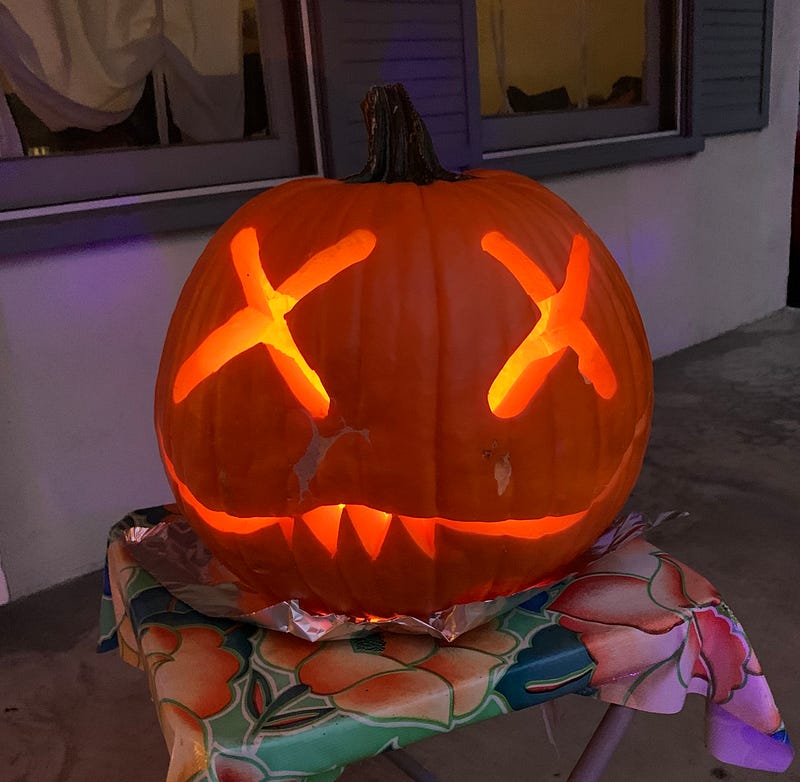
Michele carved a pumpkin
I let the kids choose their favorite candy themselves. This can sometimes lead to a prolonged choosing process and debate. The moments of “OMG” and “wow” are wonderful as they realize the candies are full size.
Hearing the kids get excited about full size candies makes it all worth it. Airheads were popular last year and we bought 4 boxes this year. Every single one was taken.
When people come to the door, I ask every person what they were dressed as and wrote down their answers. I am careful to ask what they are, accepting their answers rather than interpreting what I see.
The time-lapse takes place over a little more than three hours that is reduced to just under two minutes for your viewing pleasure.
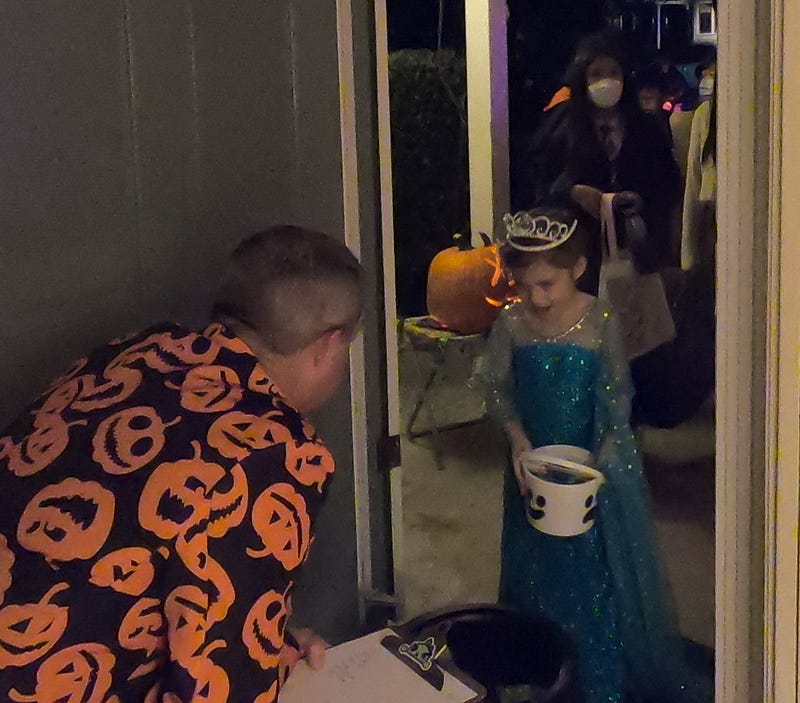
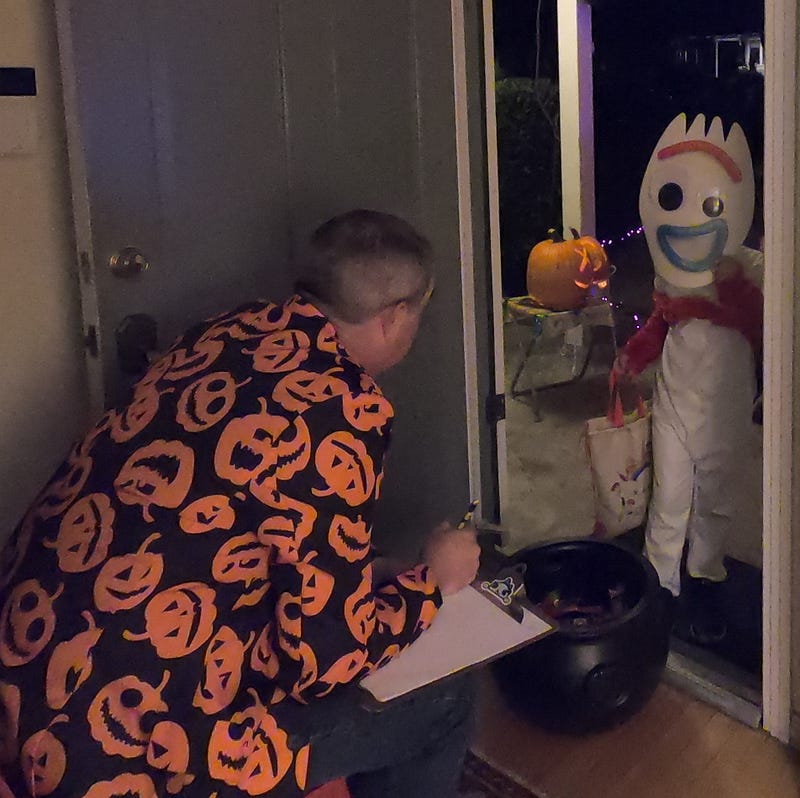
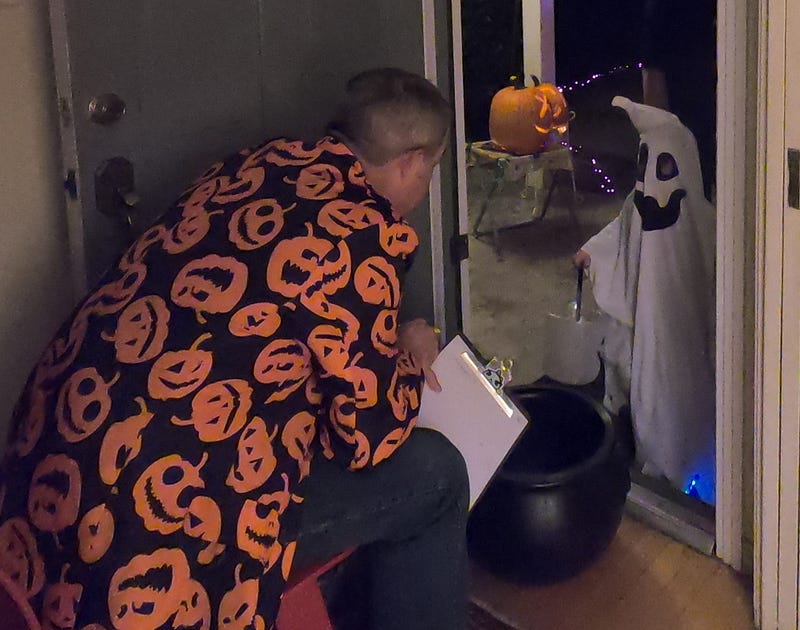
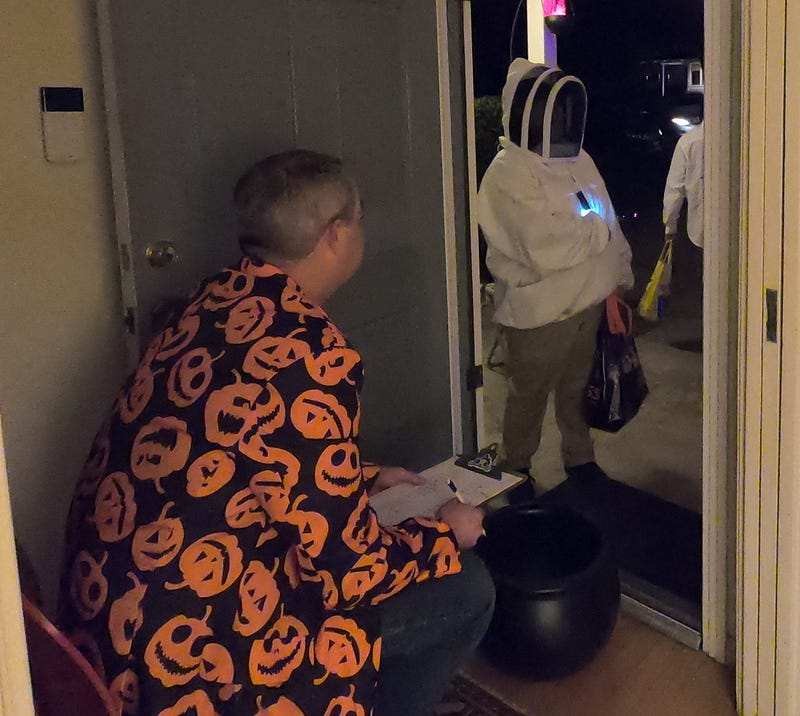
One of the Elsas that visitedThe interesting Forky costumeThe iconic ghost chatted with meBeekeepers showed up! We chatted for a bit and I gave them some of our honey.
You can see the clipboard I use to write down what the kids tell me they are dressed as.
A big bump in visitors this year. Quite a busy night.
No surprises with the top costumes many of the generic favorites toward the top, with stronger showing by the girl costumes for Elsa and Spidergirl. Several complicated Anime costumes were on display, but a bit esoteric for me to recognize easily.
This year’s complete costume list of 182 people:
1 Air Force Pilot 1 Among Us 2 Anime Person 1 Anna 1 Aoi from Demon Slayer 1 Ariel 1 Army Man 1 Astronaut 1 Baby 1 Baby Shark 2 Banana 1 Basketball Player 2 Beekeeper 1 Bendy 2 Black Panther 1 Captain Jack Sparrow 2 Cat 2 Cheerleader 1 Cher from Clueless 1 Cholo 3 Chucky 3 Clown 1 Cookie Monster 1 Corpse Bride 1 Cowgirl 1 Darth Maul 1 Dead Lumberjack 1 Deadly Doll 1 Deer 1 Demigorgon 1 Dino Ranch 1 Dinosaur 1 Doctor 1 Dosamma Dosa 1 Dracula 1 Dragon 2 Edward Scissorhands 1 Elastagirl 2 Eleven from Stranger Things 4 Elsa 1 Famous Skeleton 3 Fireman 1 Forky 1 Fortnite Character 1 Ghost 1 Ghostbuster 1 Ghostface 1 Gir from Invader Zim 1 God of Death 1 Green Guy 3 Grim Reaper 1 Grim Reaper from Fortnite 1 Gudetama 1 Guy who got picked up by an alien 1 Hacker 1 Harry Potter 1 Hermoine 1 Hot Dog 1 Huggy Wuggy 1 Iris Wilson 2 Jack Skellington 1 Jesse Pinkman 1 Jester 1 Justin 1 Kim Possible 1 Ladybug 1 Lava Girl 1 Lebron James 1 Leonardo TMNT 1 Lion 1 Little Red Riding Hood 1 Luigi 1 Lumberjack 1 Mandalorian 1 Marty McFly 1 Mexican 1 Mexican Witch 1 Michael Jackson 1 Michael Meyers 1 Mickey Mouse 1 Monster High Doll 1 Mormon 1 Mummy 1 Murderer 2 Naruto 1 Neighbor from Home Improvement 1 Nerd who works for Meta 2 Ninja 1 Pain 1 Penguin 1 Pennywise 2 Plague Doctor 1 Playboy 1 Policeman 1 Pom Pom Purin 1 Princess 1 Princess Peach 2 Prisoner 1 Quiet Girl 1 Rabbit 1 Radioactive Person 1 Rainbow Fairy 1 Random Costume 1 Rapunzel 1 Robot 1 Robot from Evanglion 1 Sally 1 Sam from Trick or Treat 3 Scarecrow 1 Scary 1 Shark 1 Sith Trooper 4 Skeleton 1 Skunk 1 Slim Shady 3 Snow White 1 Sondra from Demon Slayer 1 Sonic the Hedgehog 1 South Pas High School Cross Country 3 Spidergirl 3 Spiderman 1 Spongebob Squarepants 1 Squid Games 1 Stitch 1 Strawberry Shortcake 1 Superman 2 Teenage Mutant Ninja Turtle 1 The Joker 3 The Purge 1 The Weeknd 1 Thor 1 Tiger 1 Trea Turner of the Dodgers 1 Turtle 4 Unicorn 1 Wendy from Wendy’s 3 Witch 1 Zombie 1 Zombie Girl
It’s been almost two years since my company sent everyone to work from home due to the pandemic, but I’ve been in the office, keeping the lights green and the wheels spinning.
I wrote a short piece on what the first year was like. The tl;dr is the beginning was crazy, inventing a way to do our work from home, the middle was people beginning to get used to the new way of work, and the end was wondering what life would be like in the Aftertimes.
This is your update for those keeping score at home.
The second year began with the rush to get vaccinated, a topic of the watercooler talk that the limited skeleton crew engaged in daily. Before vaccines became politics instead of public health, the desire to get the shot was a big deal. People exchanging tips on how to get a slot and talk about the differences between the types of vaccines.
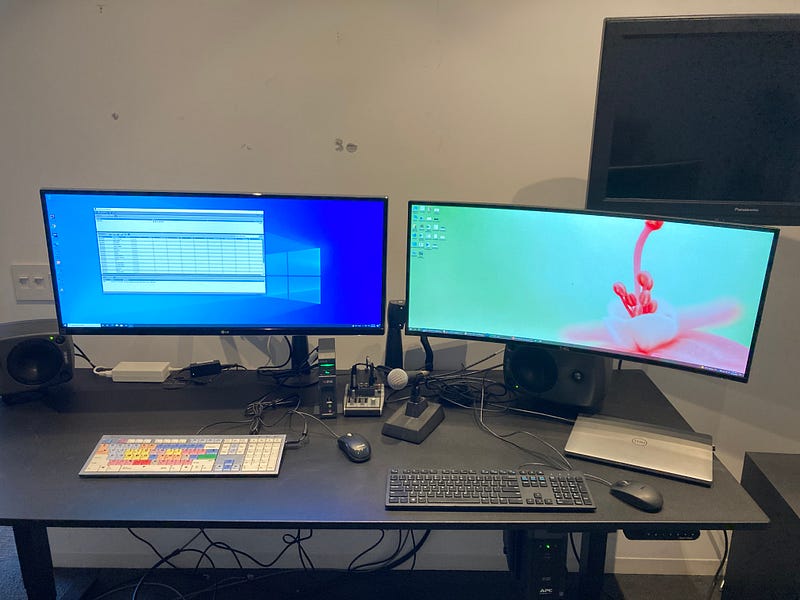
Our work is a lot of video and graphics post-production that requires specialized hardware and systems. The first methods we put in were good, but not great. We didn’t have a lot of choice in the early days of the pandemic, but now people were complaining. As with many things in technology, amazing innovation gets taken for granted after a short amount of time.
The basics in place for a return to the ‘hybrid’ office
So the team did a lot of work to put in a third generation of work from home tech: Zero Clients, Teradici, Leostream, DMZ servers, etc. Getting this done in the Beforetimes would have been hard, but considering the hurdles in place from cybersecurity, procurement, licensing, and literally just racking hardware on a locked down studio lot, it took calling in every favor we had to get it working.
In the meantime, other execs were getting pretty demanding about getting everything running faster, better, cheaper. They had adapted to WFH and all our miracles from the year before were expected as a bare minimum.
The new solutions required us sending equipment to people and getting them to stop using the old methods to move onto the New & Improved methods. This was slowed by a couple facts.
First, people have moved away from the local area. I can’t say I blame them. But now we were dealing with a workforce spread across the United States. No longer would a simple courier do. We were now in the business of packing up and shipping full kits, including monitors, all over the place. Doesn’t sound like a lot, but on top of all the other tasks the on-site team had to do, making these shipping arrangements and hauling boxes across the lot to the mailroom was a pain. Hearing complaints about slow delivery had me resort to getting up from my desk and walking a lap around the floor to calm my emotions to avoid saying how I felt in the moment.
Second, people hate it when you move their cheese. Even though the old system was not as good as the new, people became accustomed to it. We’d send new kits, and they would stay unopened or unused. Invariably, we’d receive a report about slow remote performance and then find that the person never started using the system we had put effort into building out and sending to them. It’s hard not to feel emotion over this kind thing. Hard to put into words. Maybe a kind of disrespect or dismissiveness about the kind of work we do on a daily basis? We tried to never let it show, as it wouldn’t be helpful, but it leaves a mark after you feel those things.
Outside of our normal role in technology and operations support, our division felt that year two was a good time for a major re-org and moving entire floors of people from building to building. Not a bad thing, but with hardly anyone on the lot, it’s a lot of complicated planning. The enterprise IT team did decide to do a major upgrade to people’s workplaces in terms of monitors and other desktop gear. This was a great idea that will make a difference in the long run to have large new monitors and other new kit to plug laptops into. I am glad this expensive decision was made to help out the average staff member.
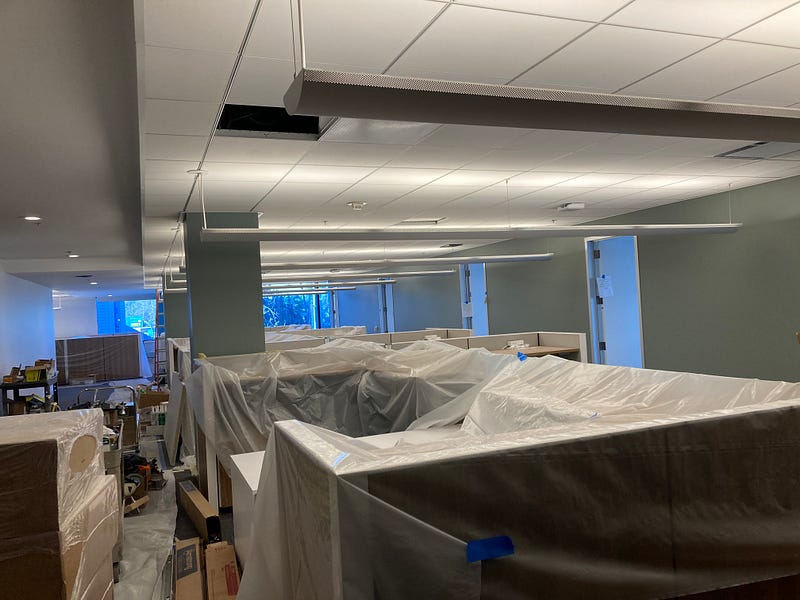
That left us to coordinate several complicated things: moving the technical post-production gear, deploying new desktop hardware, reconfiguring conference room systems, new networking requirements, and the decommission some edit rooms and the build out a few new ones. With actual construction required to pull it off, time was of the essence to get plans locked in and get the work done in the elaborate sequencing needed to get it done smoothly.
However, no proposed floor seating plan survives contact with senior executives. It is known.
As a result, the floor plan is delayed later and later causing issues for all the trades, which were under tight deadlines to somehow have everything ready for a Return To Office (RTO) in early Fall 2021. This seemed impossible at the time.
Fate intervened, and the “RTO” date kept getting pushed out further and further, as the virus surges continued. Target dates went from September to October, then to January. When Omicron hit, the company went back to bare minimum status and the early returners were sent home and once again we were down to 5–6 people on a floor meant for 300.
Non-stop construction
A word about the trades. Like our team, work from home didn’t apply to the others on-site getting stuff done. Year one was full of overdue maintenance projects and a lot of things that benefitted from no one being in the buildings.
We worked alongside the various carpenters, laborers, sparkys, tin-knockers, tapers, and other trades dealing with the extensive rules of COVID safety. No one complained. But there was a common frustration with “the managers” that expected work to proceed at Beforetimes pace, even if supplies were slow to arrive and just getting on the lot required going through the gauntlet of temperature checks, questionnaires, and other health safety theater.
Our group is lucky to have free drinks and snacks on our floor and shared them openly with everyone. We’re all in this together and have to help each other out, even with the small things. Getting a free bag of Doritos in the middle of a hard day can make a difference to someone. That idea seems to be lost on the national level these days.
The other group to talk about is the Human Resources (HR) teams, who also have been pushed to the limit. The constantly changing rules about safety, who can come into the office, how to handle the constant churn of people moving on to other companies, onboarding folks that have never set foot in our building, and dealing with all the drama about vaccine rules.
They must need hipboots to wade through all the bullshit surrounding them. Getting decisions handed down from the highest part of the corporate structure, and then trying to work with line managers to implement these complicated plans that look nice on presentation decks, but are unworkable in the real world. Couldn’t pay me enough to deal with that kind of stuff.
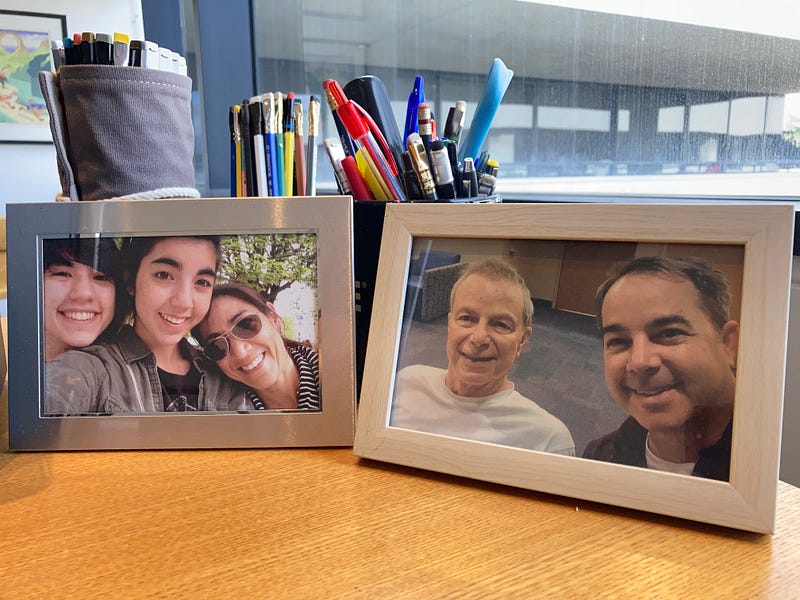
In my year one piece, I talked a bit about what it was like to walk into other people’s offices and see their personal items. Our second year included a reorg that resulted in layoffs. Adding in the office moves, we were in other people offices a lot.
The Facilities team helped a lot with the packing needed, but we often got asked to retrieve some personal items for co-workers that had been let go. I was happy to help, but it sucked to be the one packing up their old life into cardboard boxes at such an uncertain time.
Desks are full of photos and mementos that are worthless to most, but priceless to the owners. Tossing them into cardboard boxes haphazardly felt kind of disrespectful to be honest.
Meeting people outside as they handed off their badges, phone, and other company stuff since I was the only exec around is in the no fun category of management. I guess tearful goodbye hugs in a once in a century pandemic has become the norm. Doesn’t make it any easier.
After spending most of the fall and winter prepping the building, working with our local IT and facilities teams, we are ready for the long awaited “RTO” when people return to our building. Things are prepared to allow people to work ‘hybrid’, meaning a couple days at home and couple days in the office. Each group and department is going to do things a little differently, but we are as prepared as we can be.
I have to keep in mind that no battle plan survives contact with the enemy and be ready to adapt to new, unplanned needs.
The truth is I’m exhausted. The team is exhausted. The trades are exhausted. While the work from home folks may have found their happy place, it feels like we have carried the org on our backs for two years and many seem to take this for granted.
Seeing other people dialing in while sitting in the sun outside or hearing about trips to Hawaii while we’re sitting here trying to keep the wheels on takes its toll on empathy for others.
And I have it fucking easy. I can’t imagine what nurses, grocery clerks, wait staff, delivery folks, and others have to deal with with an increasingly selfish public. There’s an awful lot of hard working people out there fed up with this bullshit and the baffling expectations that people have these days.
Yes, I know that the people working from home are working hard and have their own struggles with the situation. While the remote work situation does allow business to get done, it really doesn’t let people get in sync emotionally and create the empathy and understanding needed to keep a team together. Humans are are just monkeys with clothes on and emotions drive a huge amount of how we react to each other.
I try to de-stress by eating my lunch out on a dusty balcony away from my computer and just watch TikTok for a bit. I still water the plants and try to keep these mascots from fading away.
I just don’t know when we get to an ‘end’. The need for all this remote tech isn’t going away. Ever. They are hiring people in Massachusetts, Georgia, Florida, and many staff have moved away permanently. This new second job and tech stack is here to stay.
People talk of the ‘new normal’, but I don’t know what that really means.
If I have learned anything over the last two years, it’s that people are more adaptable and inventive than I thought possible. That is a good thing. Too bad it came at such a cost to learn.
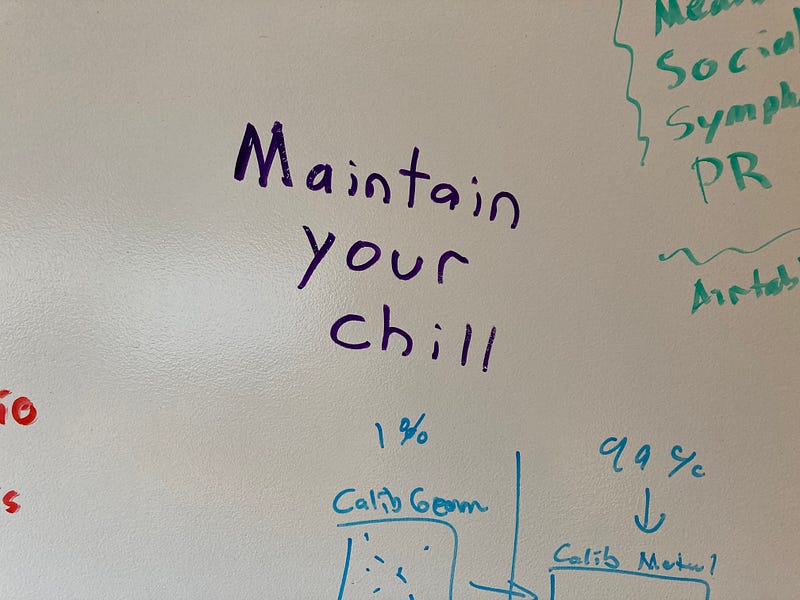
My mantra for the pandemic has been ‘Maintain your chill’, written on the wall behind my desk. I’ve done my best. Hopefully the Aftertimes will allow a little recharge of our collective chill.
1. We give out full size candies 2. Make a listing of all costumes 3. Make a timelapse movie
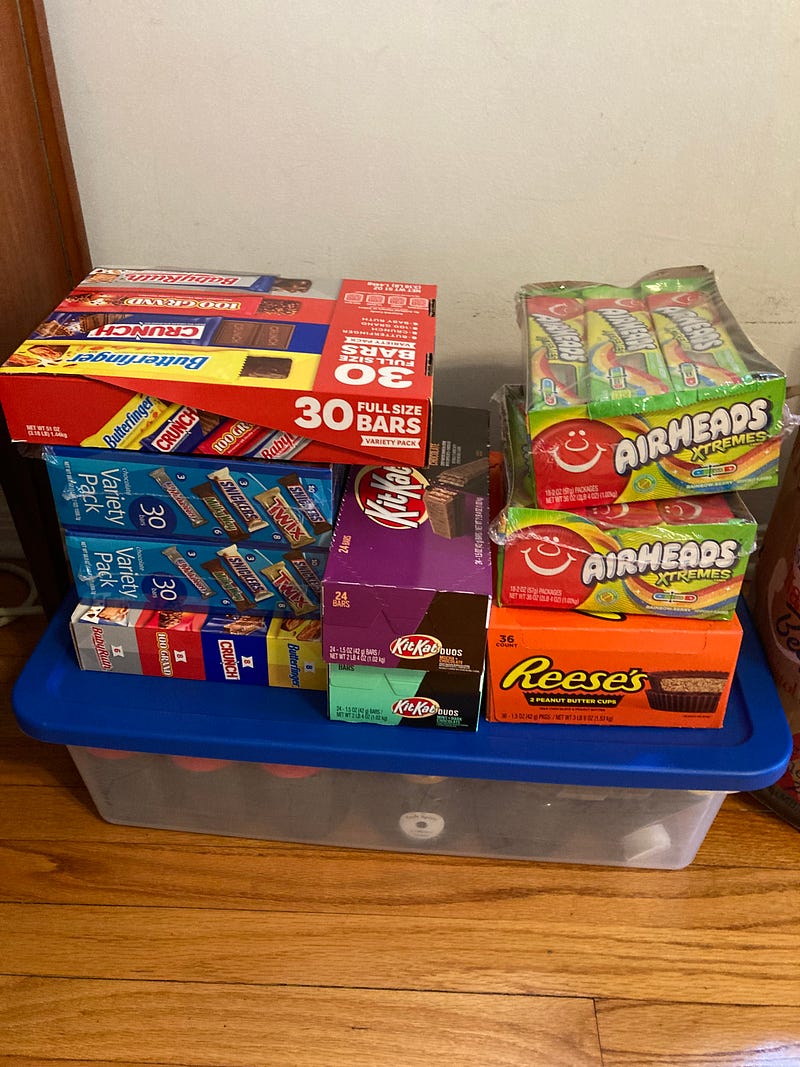
~200 Full Size Candies
I let the kids choose their favorite candy themselves. This can sometimes lead to a prolonged choosing process and debate. The moments of “OMG” and “wow” are wonderful as they realize the candies are full size.
Hearing the kids get excited about full size candies makes it all worth it. The Airheads were the first pick of most, so we’ll get a lot more next year.
When people come to the door, I ask every person what they were dressed as and wrote down their answers. I am careful to ask what they are, accepting their answers rather than interpreting what I see.
The time-lapse takes place over a little more than three hours that is reduced to just over two minutes for your viewing pleasure.
Michele carved us nice pumpkins!
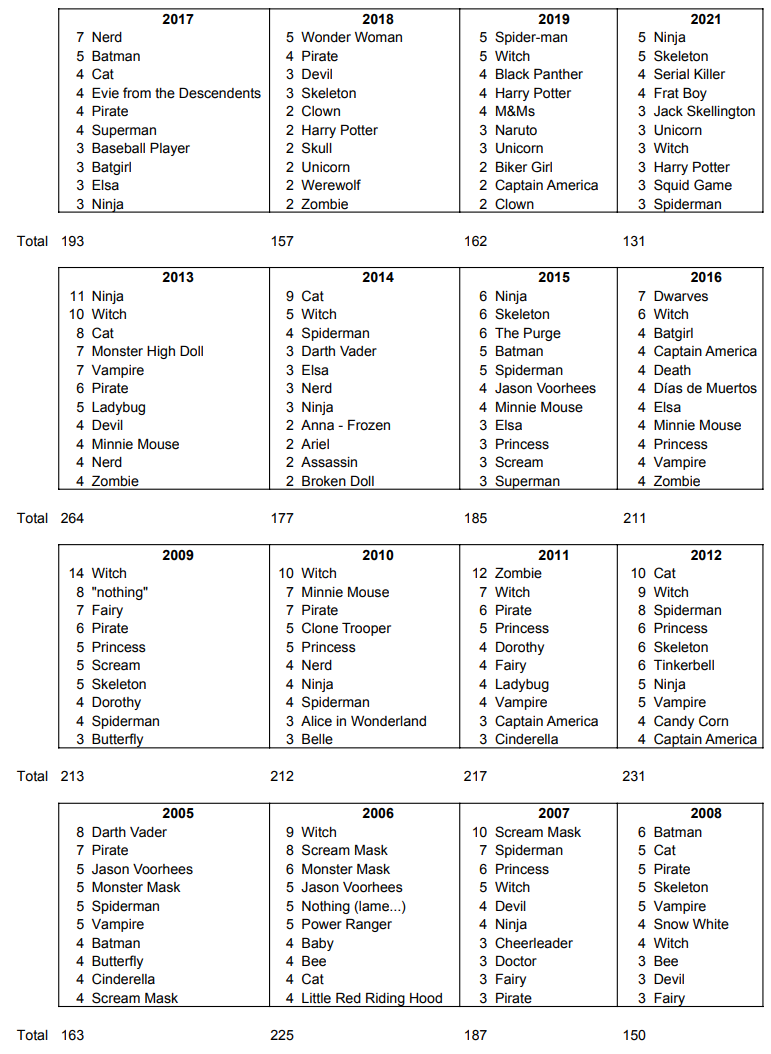
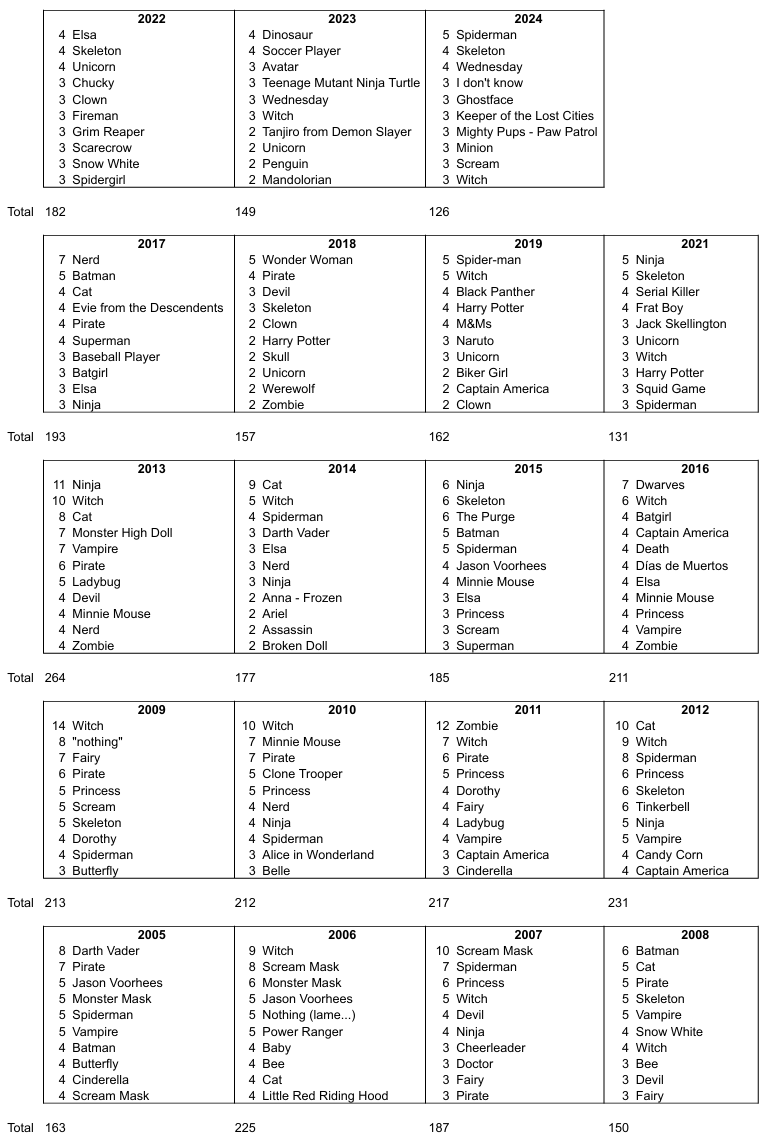
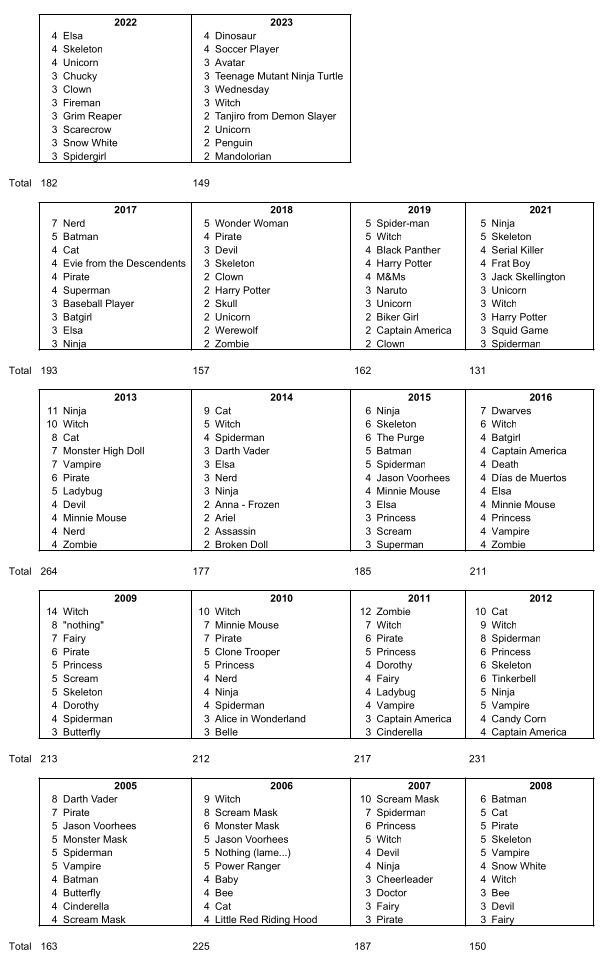
This Halloween makes it 16 years of data to compare, though 2005, 2006, 2007, 2008, 2009, 2010, 2011, 2012, 2013, 2014, 2015, 2016, 2017, 2018, 2019. We did not give out candy in 2020 due to the pandemic.
Here are the top ten costumes for the last sixteen years compared.
No big surprises this year. Squid Game related costumes were new. ‘Frat Boy’ is what a group of teenagers called themselves since they were wearing no costume. No politics related costumes at all.
Our total number of visitors was down a bit to 131, no doubt due to coronavirus concerns. Also, several homes on our street had their lights off and probably lead to lower traffic to our house.
This year’s complete costume list of 131 people:
1 “I forget” 1 50s Girl 1 Ariel 1 Arrow 1 Astronaut 1 Baseball Player 2 Bat 1 Batgirl 1 Batman 1 Beach Boy 1 Black Witch 1 Bunny 1 Captain America 1 Cat 1 Chocolate Cat 1 Cinderella 1 Clown 1 Cow 1 Cowboy 1 Cowgirl 1 Da Babby 1 Dead Skateboarder 1 Death Mask 2 Dinosaur 1 Dog 2 Dogwalker 1 Elmo 2 Elsa 1 Evie 1 Face Makeup 1 Farmer 1 Firday Night Funkin 1 Firefighter 4 Frat Boy 1 Freddy Krueger 1 Frog 1 Gask Mask Person 1 Ghostface 1 Good Ship Everstuck 1 Grim Reaper 1 Guy being kidnapped by an alien 1 Harley Quinn 3 Harry Potter 1 Hermoine Granger 1 Homeless Person 1 Hush 2 Jabberwocky Dancer 3 Jack Skellington 1 Jennifer from Jennifer’s Body 1 Joel from Love & Monsters 1 Katniss Everdeen 1 Killer Clown 1 Lava Reaper 1 Little Boy 1 Malificent 1 Man in Black 1 Mandalorian 1 Mermaid 1 Military 1 Minecraft Hammer 1 Naruto 5 Ninja 1 Phantom 1 Pikachu 2 Pirate 1 Plague Doctor 1 Poison Ivy 1 Police Officer 1 Predator 1 Princess 1 Princess 1 Queen Bee from Lady Bug 1 Sally 1 Scarecrow 1 Scream without mask 4 Serial Killer 1 Siracha Bottle 5 Skeleton 1 Skeleton carrying man 1 Sora from Kingdom Hearts 1 Spidergirl 3 Spiderman 3 Squid Game 1 Squid Game Boss 1 Stormtrooper 1 Strawberry Cow 1 Sumo 1 Susie from Deltarune 1 Tech Worker from BTS 1 The Hulk 1 Triangle from Squid Game 1 Undertaker 3 Unicorn 1 Venom 3 Witch 1 Witch w/ broom 1 Wonder Woman 1 Zenitsu Agatsuma 1 Zombie Ballerina
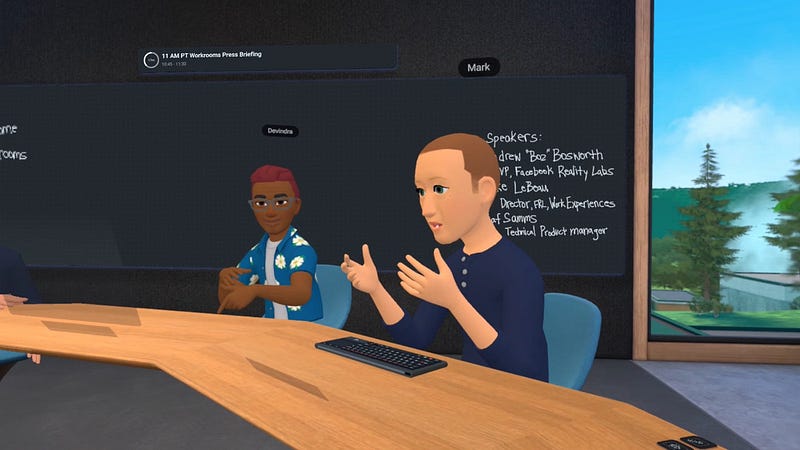
Silicon Valley denizens are making the rounds bloviating on their ideas about the ‘metaverse’ which basically are nonsense vehicles for selling more eyeballs.
No actual human wants to do this
Life is suffering and people want an escape from reality, somewhere to find solace and happiness.
No one finds solace in a business meeting.
The truth is the metaverse already exists in various places and people are living virtual lives there, without the help of the Silicon Valley echo chamber.
How do I know? Because I’ve been in a sliver of it for over 10 years, part of a huge virtual community.
In meatspace, I’m a bog standard corporate tech exec. I get my fill of meetings.
Why the fuck would I want to go into VR meeting room in an avatar that looks like me and talk about bullshit when I can be an immortal pilot flying a world killing spaceship, part of a group of like minded individuals settling a grudge against another group who wronged us in the past.
In the metaverse, I lead a global group of thousands of individuals that can be spurred into action by a single Slack or Discord message.
Space war is much more fun than a virtual shopping mall
Our IT stack is larger and more resilient than most companies on earth. We have divisions for HR, military, finance, infrastructure, technology and more that coordinate 24/7/365 on short and long term objectives.
We have logos, mascots, slogans, salutes, and even a mission statement.
Living in the world of EVE Online, a simulation video game about spaceships and solar systems, we are only one of many other groups that have similar capabilities.
We have diplomatic deals more complex than pre-WW I Europe, hurl thousands of players at each other in wars that go on for years, and run an entire free market economy based on virtual construction of in-game resources.
We get to be a whole other person, as disconnected as we want from the banality of our meatspace reality as we want. To think that people want their virtual life to replicate what is ‘real’ is to miss the entire appeal of the metaverse.
It’s not all fantasy though. The interpersonal relationships we have are strong and enduring. We hold vigils when people die in real life, larger than most funerals. We have organized support groups for mental health and other issues.
People want the un-reality of the metaverse
Let’s be honest, despite all their well-rehearsed and focus group tested talking points, the Silicon Valley/VC world is solely about making money.
They can only envision a metaverse that they can relentlessly monetize and control to maintain optimal growth KPIs to appease the board of directors and Wall Street.
They give no fucks about the long haul truck driver logging in after a long day to become a military commander. They give no fucks about the queer young person stuck in a rural area that can live their truth online much more than they can in their hometown. They give no fucks about the person with untreatable terminal cancer that becomes the respected fleet commander with hundreds acting on their words, in complete control of this part of their life.
These metaverse communities exist all over the universe, many in video gaming, but popping up elsewhere. They aren’t easy for tech giants to make money on because the allure of the metaverse is the freedom and opportunity that technology platforms are designed to control.
There are global communities everywhere that are creating their own version of the metaverse based on a variety of technologies. Discord was intended to be a chat tool for video gamers but has been pressed into service as the defacto standard community for artists using NFTs with their creations.
These key aspects of people wanting to associate in common interests and enjoy a metaverse not bound by real world constraints are antithetical to the Silicon Valley goals of monetization, DAUs, and algorithms driving engagement.
The proponents of this ‘corpoverse’ can’t imagine a world not driven purely by the tools they already have. When all you have is a hammer, everything looks like a nail. All they have are algorithms to try to force new interactions on people. Unfortunately, that’s not what builds communities and communities are the core of the metaverse that already exists.
Despite all the slick marketing, there is no heart & soul in the kind of metaverse Silicon Valley is advocating. It’s a cold and calculated effort to create and control the communities of the future. It has nothing to do with people and giving them a way to find some joy in life.
People want escape from the constraints of the real world and all the ‘corpoverse’ offers is rules and control.
In the words of Chuck D, “Don’t believe the hype.”








 Michele carved a pumpkin