I read this book on during a business trip to Orlando a week or so ago, but since I am lazy, I am only writing the review now.
Woken Furies – Richard K. Morgan
Woken Furies is the third Takeshi Kovacs novel from Richard Morgan. I’ve reviewed the first and second books previously. Takeshi is the sci-fi equivalent of a film noir detective. Set in the far flung future, Takeshi is an ex-government operative with training and skills that give him a decided edge over the bad guys, kind of like a cybernetic Jason Bourne.
In this novel, Takeshi is once again drawn into a sticky situation and get up against powerful foes quickly. I did enjoy ‘on-the-lam’ portion of the book and like Morgan’s way of showing you the cool interesting side-story but not letting it take over the main thrust of the book.
Later in the book, once you are fully rooting for Takeshi, you are shown the dark side of our ‘hero’ and given a bit of an alternate view on his actions. Morgan obviously makes his a disgust of fundamentalist thinking a key point of this story. This theme is a key element of his writing in previous novels as well. Taking a departure from previous writing, in this novel he tries to point out that taking the fight to extremes makes you no better than those you are fighting. There aren’t a lot on consequences for Takeshi as a result of his ‘bad’ actions, but it is acknowledged.
The wrap up of the story is fairly good, straying a bit into the Deus ex machina zone, but considering that you are reading a novel where characters can download their consciousness into different bodies regularly, you have to accept mysterious technology playing a role in the story.
Overall, a good read. Too bad I finished it in two days. Next time I won’t start a book on a five hour plane ride.
Category: Reviews
Who needs an iPod?
Disclaimer: I work for Disney and heard about this product at work.
Zoe and Mira, my daughters, had been talking about wanting iPods for a bit now. I really didn’t want to do that. Mainly because of the issue that they’d need to run iTunes to manage feeding music into the iPods and dealing the syncing and other iTunes specific issues.
At work I saw a demo for Disney Mix Sticks, a new MP3 & WMA player that is hitting the shelves now. It’s a basic mobile MP3 player with a few neat features.
Last weekend the girls and I picked up a pair at Target and they have been a big hit.

Like a Shuffle the Mix Sticks don’t have a screen. The buttons are in a familiar Mickey shape and the headphone plug is on the bottom. The girls picked up on how to operate them quickly without any instruction from me.
They come with headphones and matching lanyards. Since they are Disney products the lanyards are special child-safe ones that break away to avoid the possibility of injury. Someone has got to think about these things…

The bottom cap comes off and you can see the USB connector. To charge the battery and transfer files, the Mix Stick simply plugs into a USB port. The Mix Stick appears as a standard disc drive. Open up the directory and drag in the files you want. There’s some software that came with it, but I didn’t even load that up. Simplicity is best.
I can plug these into any computer at home, open up the media share and drag in what ever music the girls want. No software, no syncing, no restrictions.

The innovative feature is the ability for the Mix Stick to take a SD or MMC flash memory card to expand up to 1 GB of storage. Disney is selling albums on MMC cards in DRMed WMA format for kids that want Disney music without having to rip CDs.
I took a spare MMC card I had and loaded a few MP3 files onto it and inserted it in the Mix Sticks. The songs played fine and the memory was expanded.
I did the math and was a little suprised. The Mix Sticks sell for $50 with 128MB of memory. A 512MB SD card costs between $25-$35.
Disney Mix Stick expanded to 640 MB = $75-$85 ($50 + ($25-$35) )
Apple iPod Shuffle 512MB = $99
So you get more memory for less money with the Mix Sticks. Who woulda thunk? Not to mention the idea that you could keep several flash memory cards and swap them in and out of the player as needed.

I don’t have a Shuffle to compare size with, but here’s how they compare to the new iPod.
Moen Revolution
A few weeks ago, I read about the Moen Revolution showerhead on Matt Haughey’s site. Our showerhead was seven or eight years old, so I decided to give it a try.
The install was a breeze. Just unscrewed the old showerhead, applied new teflon tape, and screwed the new Moen on.

I turned the water on and let the thing rip. The first thing you notice is the handle on the bottom to steer the water. It feels natural and moves smoothly. The dial on the handle is to change the kind of water stream flowing out.

The handle does drop down a bit and was bumping into the highest shelf of the shower caddy thing. I finally removed the top shelf and all was well. Michele decided that this would ‘not do’ and is now on the hunt for a new shower caddy thing that can accomadate the size of the Moen.
This is what I would consider the main showering mode. Plenty of water and not a lot of force. The children and I both think this is better than the old showerhead.

Next I tested out the special mode. It’s described as “Moen’s patented Revolution technology takes ordinary water, spins each drop, then twirls the entire shower stream.“. Well, it’s kind of like one of those kiddy toys for the backyard that whips around in all directions. Fun the first time, but no use for washing. And the flow isn’t strong enough to be considered a massage mode.

This mode is the massage mode. But it’s not much of a massage. The stream is just more than an inch in diameter and just doesn’t have enough force to be considered a real massage mode. Now, maybe some dainty princess type might like it, but it was a disappointment to me.
Conclusion: The Moen Revolution is a nice showerhead, but it’s not revolutionary in any way except the handle. If you like the way it looks, get it. If you are looking for one of those back-massaging showerheads, this ain’t it.
Three more books
Neverwhere – Neil Gaiman
Ever since I read American Gods, I’ve been a fan of Neil Gaiman. Michele bought and read this book before I did and said it was great. She liked it so much that she tracked down the DVDs of the BBC production of the book and watched that as well.
Needless to say, it moved to the top of my reading stack.
The story takes place in a Gaimanesque world where the world is oblivious to the magic world that surrounds and permeates it. After living a normal life, our protagonist, Richard Mayhew finds himself slid out of his reality and into the Underground.
His adventures take place in the world that exists in the under London. Below is a fantastic place of history, magic, and the supernatural where the base currency is one of ‘favors’. Each chapter gives glimpses of the world and then pushes you forward leaving you craving more about what is hinted at. Enjoyably, each new chapter brings more interesting things to ponder.
Like American Gods, the only problem with the book is that it ends. As you finish the book, you want more, much more about the world that Gaiman describes. The story touches on other places and people that you want to know more about.
Supposedly the upcoming book, Anansi Boys, is similar in delving into Gaiman’s vision of the supernatural. I look forward to it with baited breath.
The Merchants of Souls – John Barnes
This is that latest book in the Thousand Cultures/Giraut series that Barnes has created. In this series, humanity is mending itself back together after splitting to hundreds of planets with thousands of cultures. The idea being that planets were colonized based on specific cultures to allow harmony as they developed. Imagine cultures devoted to such varied ideals as Tamil Poetry, Occitan Chivalry, Calvinism, a pure military society, and even a pure hedonistic society. The invention of the ‘springer’ and instantaneous transportation device that can span the light years arrives to weave the culture back together in some fashion. Chaos ensues.
This book takes place mainly on Earth and involves the challenge of the OSP (the good guys) to face down the billions of Earth people living in virtual reality their whole lives. The bad guys want to use stored copies of people’s consciousness as virtual playthings fort their virtual lives. The OSP must stop this.
Barnes touches on several interesting ideas in a future world when machines do the work and all that is left for people to do is think and create. He touched on these ideas in the other novels, but examines then a little more deeply in this book.
Still, it’s science fiction and the story involves murder and misdirection in a hard sci-fi world. Barnes is good in this aspect, with consistency and refusing to solve the issues with miraculous invention in the nick of time. His inventions and culture are fully realized and you can understand the motivations of those involved event though it takes place in the imaginary future.
I enjoyed the book, but it’s for people that have read the first two books, A Million Open Doors and Earth Made of Glass. I’m sure you can find the first book for sale used for only a few dollars.
Idlewild – Nick Sagan
Last week when I was heading out to Utah, I asked Michele for a book to read and she handed me Idlewild. She said was good but not great. After finishing it I have to agree.
The story is a mashup of the Matrix, Stephen King’s The Stand, and a whodunit. Our protagonist wakes up with amnesia and we learn along with him about his world. A good literary technique, but the author won’t get away with using it again.
Central to the book is the concept of IVR, a form of Matrix-like virtual reality where much of the story takes place. Perhaps the Matrix has ruined the concept of virtual reality for sci-fi writers in the near term, since a lot of the ideas felt lifted, but probably weren’t.
I enjoyed the book and Sagan puts in enough red herrings and false leads that I was unable to deduce what was really going on until I read it. Most things follow but in the last couple chapters, things seem rushed with travel over distance happening way too fast and the death of a character happening in an almost unexplained way. I’d bet there are a couple more chapters that the author cut that would have made the story a little smoother at the end.
The book is good enough that I am looking forward to the follow-up, Edenborn.
Griffin Radioshark
My Griffin Radioshark arrived on Friday and I quickly hooked it up to our Media Server in the front room.
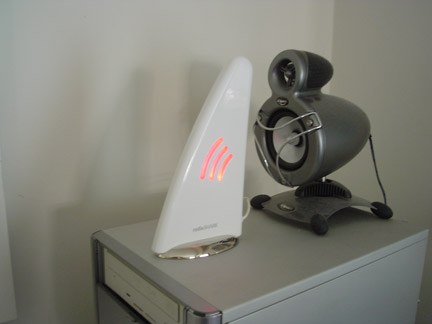
The Radioshark is a FM/AM radio that plugs in via USB to a computer, Mac or PC. I love listening to the radio on the computer and this device is supposed to give me the ability to record shows automatically.
The quality of the unit seems high with a good feel to it. The software came up quickly and in a couple minutes the radio was playing through the speakers nicely.
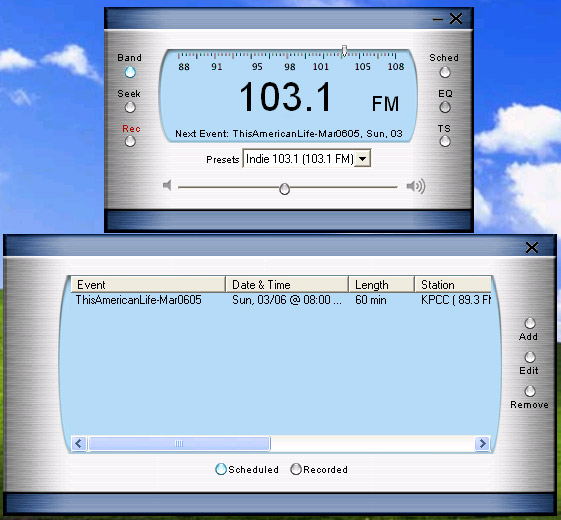
The software is, well, eh, not my cup of tea. If I’m using a PC give me the standard PC look and if I’m using the Mac give me the standard Mac look. This look leaves me flat.
The app covers the basics of tuning and setting up a recording. There are a few issues like not being able to enter a duration for the recording and having to choose one of the predetermined one. When I record something I like to record a little extra at the beginning and end. With a locked 60 minute record, you can’t do this.
You can easily schedule a recording based on time and station. The Windows version only record in wma (Windows Media) and wav files. Not the end of the world, but I would have paid $5 more to record directly in MP3, saving the hassle of conversion.
The radio reception itself was good but not great. I really want to record Indie 103.1, a Los Angeles station with a weak signal at my house. My car can pick it up, but the Radioshark couldn’t.
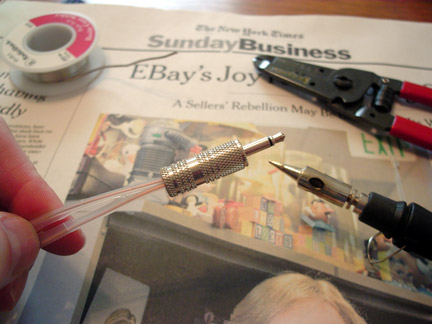
There is an input for an external antenna so I decided to give that a try. I took a standard FM dipole antenna and soldered it into a 1/8th inch audio connector.
For those that don’t know, a FM dipole antenna is specifically made to pick up radio signals and not much else. It’s what we electrical engineers call a tuned quarter-wave antenna.
BTW, I highly recommend those new-fangled butane soldering irons. They are perfect for these quick little jobs around the house.

The antenna worked but I had to get it up pretty high to pick up the signal. After standing in the room holding the Radioshark and the antenna in endless positions, I found that placing it above the curtain rod was optimal and was least offensive to Michele’s sense of how it should look.
The Radioshark was wedged up there and seemed a bit precarious. I couldn’t have it fall down on the girls as they walked by.
I removed the metal based, drilled a hole in it, and was able to attach it to the ceiling, securing it against a tumble.
Summary
Overall, the device works as advertised and most people aren’t going to be listening to weak stations. If you like radio, then the Radioshark is for you. It works, it looks good, and it’s reasonably priced.
Four more
In the last few weeks, I finished a few more books. Here’s a brief review of each.
How to Blog – Tony Pierce
Not so much a instruction manual, but a retrospective on Tony Pierce’s writings. Tony is a blogger in Los Angeles. He’s young, witty, handsome, and all the fly women are making a fuss…
Part poetry, part prose, Tony writes about whatever flutters through his mind, women, baseball, politics, even his digital camera. I found his book a refreshing and funny break from my usual sci-fi or history book diet.
Help the guy out and buy a copy, it’s worth it.
The Zenith Angle – Bruce Sterling
Amazingly, I saw this book before it was published in Bruce’s office, in his house at last year’s SXSW party. Sterling’s work has ranged from future sci-fi to steampunk to cyberpunk over the years. In The Zenith Angle he gives us his take on America’s spooks and the role of cyberspace in national security, and a taste of space warfare.
The book was a tasty treat that I consumed rapidly. You don’t always know where the author is taking you, but the road is great. Scenes of the different worlds that Bollywood actors, dotcom billionaires, and government agents occupy are tantalizing glipses of lifestyles we mere mortals don’t encounter often.
The book is a good thriller with enough tech tossed in to differentiate it from the typical DaVinci Code style book.
Confessions of a Master Jewel Thief – Bill Mason
I heard about this book from Bruce Schneier’s Crypto-gram newsletter as a good lesson in security. The basic idea -> “Nothing works more in a thief’s favor than people feeling secure. That’s why places that are heavily alarmed and guarded can sometimes be the easiest targets.”
The book is the story of Bill Mason, a noted jewel thief in the 70s and 80s. This is the story of his criminal career from start to finish. Fairly well written, you begin to feel for the guy as he breaks into places and steals pillowcase after pillowcase of jewels from the rich.
At one point however, he does lose my sympathy as he describes his antics in Florida as he was on trial from one of his crimes as he continually taunted the police and judges. I really couldn’t relate to this. I could relate to his problem solving methods and the way he concieved solving the security issues, but acting like a jackass and treating his family badly was disconcerting.
Worth a borrow from the library, but not worth a new hardcopy purchase.
The French Admiral – Dewey Lambdin
This is the second book in the Alan Lewrie storyline, another Age of Sail hero in the tradition of Horatio Hornblower. I read the first book and thought it was promising. I stumbled into this book at the library and checked it out on a whim.I’d like to say I found the novel fantastic, but it was just OK. The continual use of endless anutical jargon about staysails and other details really doesn’t do much for the tale.
It was interesting to ready about the American Revolution from the British side as Alan meets up with loyalists from North Carolina and tries to escape the Battle of Yorktown. Not many sea battles, but and few good descriptions of land battles and skirmishes.
The book does clear up quite a bit of Alan’s history and the reasons behind his banishment to sea by his father. The look into Britsh marriage law and inheritance rights is fun and makes me glad not to live under the British system of family property.
Budweiser Extra
When time permits, I try to take Michele for coffee in the mornings after the kids are off to school. She likes 7-Eleven coffee, so that’s where we go.
I’ve taken a break from caffeine for a bit and today I was wandering around while she made her coffee/hot chocolate concoction. Scanning the fridges, I saw this:

Yep, you read it right. Beer with caffeine, ginseng, guarana extract, and natural flavor.
Yes, Budweiser Extra has hit the market. Why? I have no idea, but someone at Anheuser-Busch thinks America needs caffienated beer.
Of course, you can count on the Cruft Labs to test this out for you.

I poured a tall glass of ‘B to the E’ and took a nice swig.
In a word, it is foul.
Truly a triumph of conceptual marketing over common sense. Bud Extra tastes something akin to beer with a Flintstone’s vitamin ground up in it. An amazingly terrible taste that is nothing like beer.
Avoid this product at all costs, except if you want to play a practical joke on someone.
Just a Geek
I finished up my latest book, Just a Geek by Wil Wheaton tonight. Since I’m still waiting for Halflife 2 to finish downloading, I thought I’d take some time to write up a review.
Just a Geek – Wil Wheaton
This is the first book I’ve read, where I actually know the author and about him outside of what’s in the book. I’ve met Wil several times but wouldn’t consider him a friend, more of a casual acquaintance. We’ve had some beers, chatted, and bumped into each other several times at various events in LA, but not much more than that. He’s a good guy but from our emails back & forth and insanely busy guy as well.
Most of what Wil wrote in his book was not a surprise or relevation to me since I’d been reading his blog for a long time. Wil’s writing on the blog can be a bit scattered and loose when he gets excited and I wasn’t sure what to expect from his book.
Pleasantly, I was happy to find a fairly tightly written book about what was going on with Wil for the last several years, showing both his public face and his private turmoil. Much more than a simple rehash of blog entries that some other ‘famous bloggers’ have foisted on the public.
The book deals with his coming to grips with life and becoming comfortable in his own skin. He give names to his inner voices like ‘Prove To Everyone’ that had him second guessing himself constantly. This was a little hard to for me to empathize with, since my self-confidence level is high. (Remember, I’m that ENTJ guy) But I know that lots of people have real trouble dealing with concerns over what other people think about them. I’m sure Wil’s story hits home for a lots of people.
He never launches into ‘poor me’ mode when looking at the past in the book. He looks back as a man that is finally free of the demons of the past and ready for pretty much anything.
The one thing I’ve was expecting him to discuss in his book was noticably lacking, his relationship with his fans.
Wil is a celebrity and most of the times I’ve seen him, he is dealing with fans trying to get his attention. The net makes it even easier for people to try to connect to celebrities and Wil has left himself wide open. I can’t imagine the onslaught of email and requests he gets from people constantly looking for his attention.
He had an entire community going on his site forums (bka The Soapbox) that grew beyond what he could realistically control. The community was so tight, that it now survives outside of Wil’s direct supervision. Several of the people he thanks in the book are people that he met in his Soapbox forums.
Following his schedule, I can see him getting busier and busier and sweeping more and more people in as his fans. To me the interesting story would be how he deals with the adoration, the requests, and the stalking that most celebs deal with. It’s a side of life that we civilians rarely hear about other than after a famous person gets into an embarassing situation. Wil’s in the unique position to pull back the curtain a little and show people what a celebrity has to deal with.
Now that would be a book.
The Man Who Would Be King
One of my most favorite movies is The Man Who Would Be King, a movie based on Rudyard Kipling’s novel, that starred Sean Connery and Michael Caine as British soldiers that march into Afganistan and carve out a kingdom.
Several months ago, we were ‘testing’ a conference room at work that had HDTV for an upcoming presentation and The Man Who Would Be King was on in HD. I extolled the virtues of the film. It looked damn good in HD.
A few weeks later, Brad presented me with a book about the real life inspiration for the story.
The Man Who Would Be King (The First American in Afghanistan) – Ben MacIntyre
The book is a history of Josiah Harlan, an American adventurer that went to the heart of Asia and literally become king. In the early 1800s, there were still many places on the globe that were hard to get to and where western civilization had little influence.
Harln left from Pennsylvania to travel the world ended up in India. At the time, India was under the control of Britain. To the north was Afganistan, a place of warfare and tribal control. To Harlan, this was a place to make his own name.
The book goes through the details of exactly how he did this. At one point Harlan was the Prince of Ghor, a huge area. The claim exists today and hs great, great, great, grandson was recently made aware of his royal lineage.
The story is interesting, but the book is a history textbook. I can be a bit slow, but for an avid reader of history like myself, it is a good choice. I needed a break from the spate of sci-fi I had been reading.
Katamari Damacy Rules
Last week I picked up Katamari Damacy. I saw this game at E3 this year. Andy and I agree that it looked like the best game evar.
The game involves rolling a small sticky ball around, picking up objects along the way. As you get bigger, you can pick up bigger and bigger things. You need to get your katamari to a certain size to finish the level.
There is a very Japanese like theme involving the King of the Cosmos (your father, you being the Prince…) and a strange anime family that you see in surreal snippets.
To be honest, I speed through all the translated story line since it makes no sense…
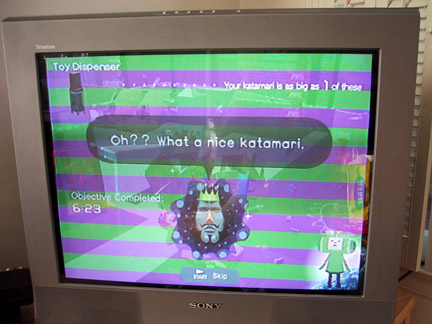
Once you get to the requested size, the King of the Cosmos congratulates you and urges you to get even bigger. The size relationships are accurate, so when you get to be three meters tall, you can pick up people and other large objects. Nothing more satisfying than picking up a pair of large sumo wrestlers.
I love it, the kids love it, even Michele loves the game…
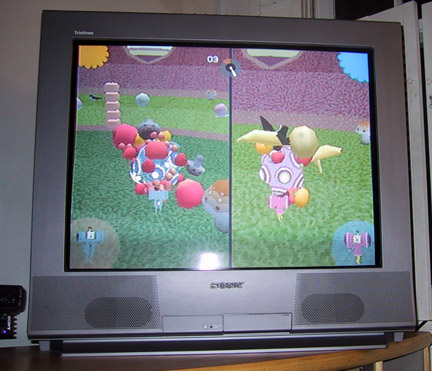
In addition to the single player mode, there is a head to head mode where you can compete. The best is when you can grab your opponent and drag them around.
You should run, not walk, to the game store to pick up this game.