I learned a lot about pain, pride, and empathy this summer.
The entire episode started with a Sunday walk in May with my wife Michele. She has a five mile loop she does and I decided to come along. I’d done it before.
On the walk, we climb a small hill, which didn’t seem much of a problem, but as we got down to the base of the hill to the flats, I started feeling a pain in my lower back and down my left leg. We stopped for a bit to stretch and continued on. The pain got worse and worse the further we went. Instead of stopping and getting a ride home, I forced myself to keep going, stopping every few hundred yards when the pain became intense. Even after the walk was over, the pain continued for several days. In hindsight, this was incredibly stupid.
My childhood lessons about perseverance and pushing through discomfort, values I was taught to prize, ultimately caused lasting harm. Being taught to be tough and endure difficulty is good, but taken too far can be damaging.
The doctor said it looked like sciatica and put me on a regimen of anti-inflammatory drugs and physical therapy. The pain slowly receded.
By June I was feeling better and went back to my usual tasks and tinkering. I decided to repaint my curb numbers and got to work sanding and painting. Bending over the curb was painful, but I was focused on getting the job done, and kept working. I got the final bits done and my lower back was screaming at me.
That evening the pain got worse and worse and I had trouble even getting comfortable to sleep. The next morning, even walking was extremely painful and I went to Urgent Care the first thing. The doctor was very direct, all she could do was prescribe painkillers. I’d have to see orthopedic doctors to see what the underlying issue was and how to fix it. They gave me a bunch of opioids and sent me on my way. I really don’t like taking opioids but needed them for a couple days to get through the pain and be able to sleep. It took days to get comfortable enough to walk more than a few steps.
In July, I tried everything from physical therapy and chiropractic work to acupuncture, finally culminating in an MRI and a steroid injection to help reduce the inflammation.
This all helped reduce the pain and I slowly increased my walking to be able to go a few hundred yards before having to stop. I was hopeful I was past the worst, but I was wrong.
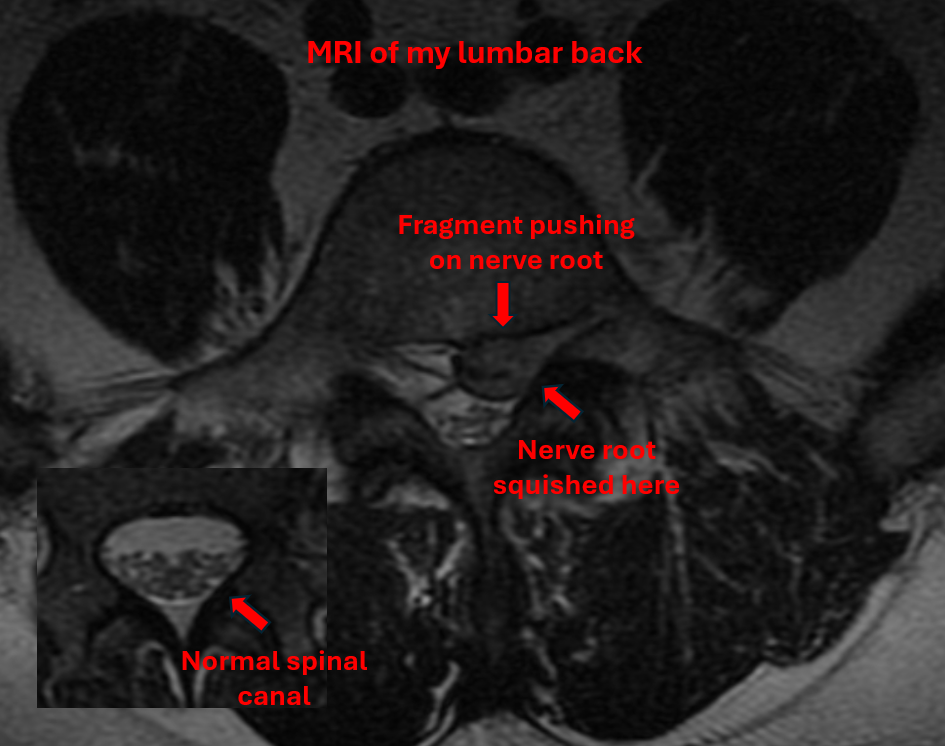
At the end of July I received the report on the MRI and it basically said there was a fragment of a disc pressing on a nerve root at my L5-S1 vertebrae. Reading it, I realized the complexity of the problem and that it wasn’t going away with rest. After reading the MRI report, my physical therapist told me I’d likely need surgery and she didn’t want me to do more work until I’d seen the spine surgeon and got clearance.
Slowly the pain diminished and I was able to do small things around the house. Toward the end of August, I was bending over the dishwasher to empty it and felt a twinge. The twinge shortly gave way to pain that kept increasing.
The pain kept escalating to a level I couldn’t believe. Words do not do justice to describe the mind-shattering and crippling pain in my back and down my left leg. There was only one position I could get relief, my back flat on the floor and my legs up in a L shape, on a chair or ottoman. Even with the opioids, even going to the bathroom was an exercise in agony, having to lie on the bathroom floor to recover.
I’ve led an active life and have broken multiple bones, torn ligaments, and had shoulder and knee surgery. I thought I knew what pain was, but again, I was wrong.
The revelation that this level of pain existed was eye-opening. I had heard people complain about back pain and having to stay home from work due to it, but never could imagine this is what back pain could be like.
After two days of this, Michele took me to the ER. She put down the back seats and I lay in the back of the car as she drove. The ER doctor shot me up with even more painkiller and told me the same thing I had been told previously, all he could do was give me more painkillers and anti-inflammatories. I’d have to see the spine surgeon to fix this.
Back home, I tried to rest and hoped the anti-inflammatories would help get me through to the appointment with the spine surgeon. Once again, I was wrong.
A few days after the ER visit I took a shower. Getting out, I was drying off and felt a twinge that rapidly became pain. Naked, I laid down on the floor, hoping to get the pain under control. But the pain just kept getting worse, reaching levels more intense than I had ever felt before. Even my recovery position and stress breathing did nothing. My brain was panicking because I knew I couldn’t endure this for long. Michele was with me and I told her to call the paramedics. We didn’t know what else to do.
Soon I could hear the sirens in the distance and before long the paramedics arrived. They did their best to extract me carefully from the bathroom and get me into the truck but I was hit with waves of pain. I answered their questions and explained the history as they placed an IV in my arm. They assured me they could help. And sure enough, they gave me a dose of IV fentanyl and the pain switched off, like they had flipped a switch. By the time I got to the emergency room, I was relaxed and in relative comfort.
Yet again, the ER doctor explained the limits of what they could do and before long I was home. More days of lying on my back followed.
I stopped taking the opioids three days after the ER visit. I found myself looking forward to my next pill and knew I had to stop.
In those days following the ER, lying on the floor and staring at the ceiling, my perspective on ‘strength’ began to shift.
Our medical insurance is good and we weren’t being saddled with debt, unlike so many others the poor or no insurance at all. Going through this kind of painful ordeal and worrying about the cost is why so many people self-medicate with drugs and alcohol.
I used to judge those who became addicted to prescription painkillers as weak-willed. However, experiencing this level of pain myself, and realizing the luxury of not having to work during it, has shown me that for many, opioids aren’t a choice, but a desperate necessity. I now see how easily anyone could fall into that cycle.
I’m ashamed it took me suffering personally to have empathy for the millions of other people dealing with chronic pain issues. The sad truth is that the arsenal of tools to deal with chronic pain too often comes down to ever-increasing amounts of addictive drugs.
My appointment with the spine surgeon was in September and we decided to proceed with a microdiscectomy to remove the disc fragment and “clean up” the surrounding area.
The surgery was on October 13th taking only about an hour. They did the entire procedure through a 1.5 inch incision. The surgeon, the OR team, and the medical technology were absolutely incredible.
There was about two days of pain afterwards, mainly from them cutting me open a bit, but the sciatic pain was gone.
After an entire summer of pain, it was gone. Gone like it never existed.
Realizing this filled me with enormous gratitude for everyone who helped me through this. Michele, my daughter Zoe and her boyfriend Christian, the nurses and doctors at the urgent care and emergency rooms, the surgical team, the inventors of the medical tools, the friends and family that let me know they were thinking of me. It’s still overwhelming now, even as I type this with tears in my eyes.
If you are dealing with back pain and hesitating to get help with it, I urge you to see a doctor and find out what can be done. Pain makes everything in life worse, even if you think you are managing it.
My recovery has gone well, gaining strength and confidence, but being careful not to create a new injury.

Getting myself to think differently remains a challenge. While being able to endure some pain and hardship is important in life, taking it too far, as I had done, is a bad thing. Deciding to take two trips to bring in the groceries from the car instead of trying to do it in one, getting help to lift a heavy box, and limiting my time sitting in front of the computer don’t come easily. I have to make the conscious decision to not revert to my old ways of thinking about pain.
It was a hard summer, but I am grateful to come away changed, having more empathy for others.